Can You Become a Professor After an IGNOU PhD?
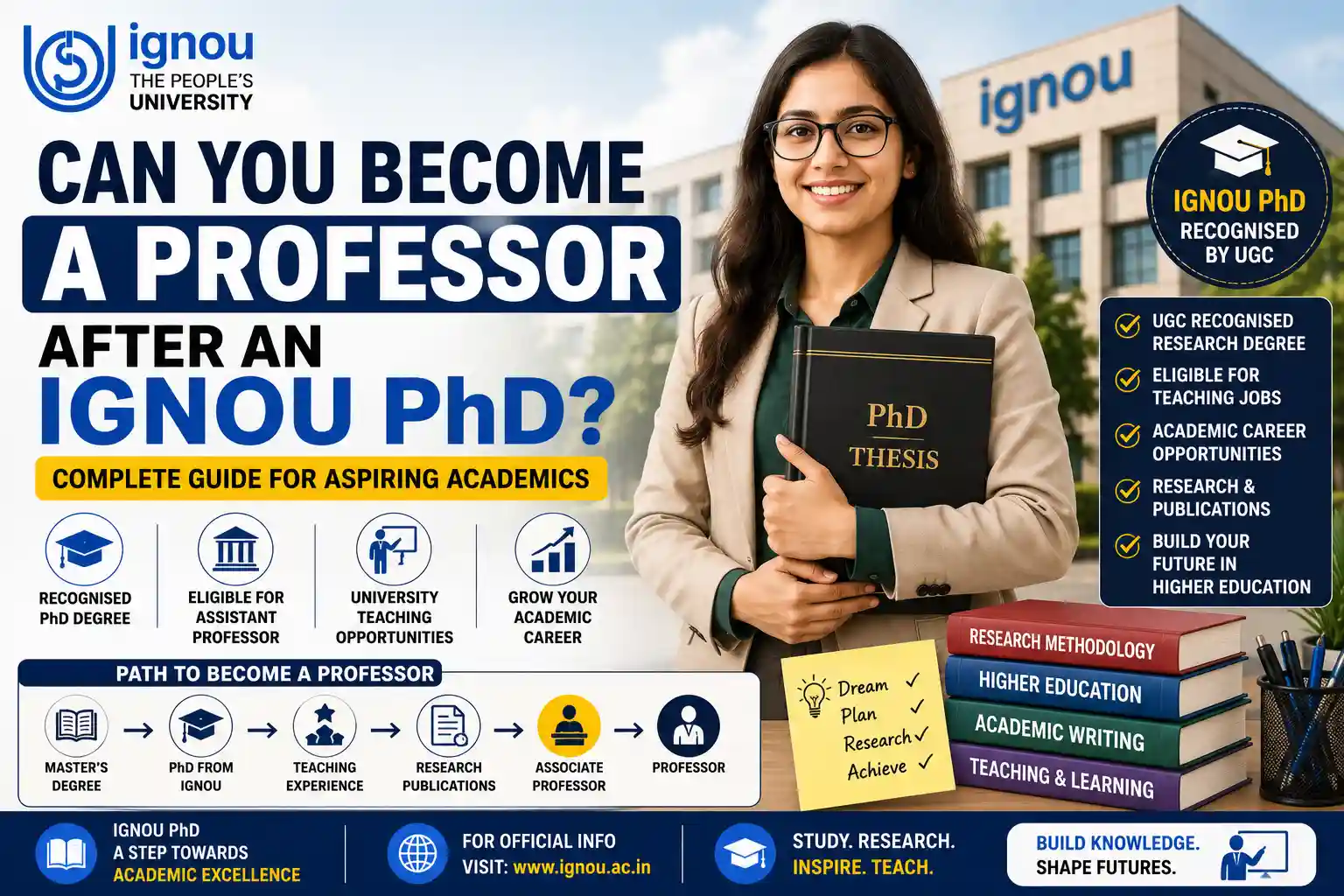
Are you planning to pursue PhD from Indira Gandhi National Open University (IGNOU)? Do you want to know if the degree will help you become a professor in a university or a college?
This is a significant question for students who want to make a career in teaching, academic research or higher education.
Yes, you can apply for University teaching jobs with IGNOU PhD as per UGC regulations and requirement of the institution. But a PhD does not make you a Professor.
In India, Assistant Professor, Associate Professor and Professor are different designations. Each has its own criteria for eligibility and experience.
Another important point is that, though IGNOU is known for distance education, its PhD programs are available in regular mode with full-time and part-time research category. These are not distance-mode doctorates.
This guide is about the recognition of an IGNOU PhD, UGC NET requirements, academic recruitment, research experience and qualifications for progress to a professorship.
1. Is an IGNOU PhD Recognised for Teaching Jobs?
IGNOU is a Central University established by an Act of Parliament. Its Ph.D. programs are conducted as per the university’s research regulations and the relevant University Grants Commission (UGC) norms.
As per the official research information of IGNOU, “IGNOU PhD programs are offered in regular mode and are governed by UGC regulations.
The university’s notification on PhD admission for July 2026 also mentions that its programs are offered as per the UGC (Minimum Standards and Procedure for Award of PhD Degree) Regulations, 2022 and its subsequent amendments.
For further details on Doctoral Research and Academic Regulations, please visit the official IGNOU Research Unit.
So, a valid IGNOU PhD is not barred from academic recruitment on the ground that IGNOU provides distance-learning education.
However, the recruiting university may require a relevant research specialization, a qualifying postgraduate degree, teaching experience, publications or other prescribed qualifications.
IGNOU PhD and Teaching Career: Quick Overview
| Question | Answer |
|---|---|
| Is an IGNOU PhD recognised? | Yes, when awarded under applicable university and UGC regulations |
| Is IGNOU PhD a distance-learning programme? | No, IGNOU offers PhD programmes in regular mode |
| Can IGNOU PhD holders apply for Assistant Professor posts? | Yes, subject to the applicable eligibility rules |
| Is UGC-NET compulsory after an IGNOU PhD? | A qualifying PhD may provide exemption under specified UGC rules |
| Can you become a Professor immediately after PhD? | Generally no; higher academic posts have additional experience and research requirements |
| Does IGNOU guarantee teaching jobs after PhD? | No |
| Can IGNOU PhD holders apply to other universities? | Yes, where they meet the recruitment criteria |
The central distinction is between having a recognised doctoral qualification and being selected for a particular academic appointment.
2. Is IGNOU PhD Regular or Distance Mode?
IGNOU provides PhDs through distance education, this is a common misconception as many of its undergraduate and post-graduate programs are offered through Open and Distance Learning.
This is not the way doctoral programs work at IGNOU.
As per the university research info, PhD programs are conducted in regular mode.
IGNOU provides full-time and part-time research categories. However, the requirements for doctoral coursework, research supervision and evaluation are same for both.
For example, an information brochure on PhD published by the university in July 2025 stated that students will do coursework for the first six months at its New Delhi campus with minimum 80% attendance.
Coursework arrangements and administrative requirements are subject to change. Students should refer to the instructions applicable to their own admission session.
What Is the Difference Between Part-Time and Distance PhD?
Part-time PhD The part-time PhD is an opportunity for an eligible researcher to carry out doctoral work while undertaking the research requirements prescribed by the university, potentially while working.
This doesn’t mean the student can do the doctorate all alone without participating in the required academic activities.
A distance PhD is a different kettle of fish.
"IGNOU is perceived as a distance education institution but this should not be a reason to label its doctoral programs as distance PhDs.
Employers should consider how the doctorate was earned, so this distinction is important.
3. Can You Become an Assistant Professor After an IGNOU PhD?
Yes, an eligible IGNOU PhD holder can apply for Assistant Professor positions.
However, appointment depends on the qualifications prescribed for the discipline and institution.
The UGC's 2018 faculty recruitment regulations, together with subsequent amendments, provide the regulatory framework for many university and college teaching positions.
The UGC issued a clarification on 6 July 2023 confirming that candidates awarded qualifying PhD degrees under the applicable UGC doctoral regulations may be exempted from NET, SET or SLET requirements for Assistant Professor recruitment.
The clarification also explains that NET/SET/SLET remains a minimum eligibility route for candidates who do not qualify for the relevant PhD exemption.
See the official UGC clarification on Assistant Professor eligibility.
What Qualifications Are Generally Required?
For many disciplines covered by the UGC's faculty recruitment rules, the usual academic requirements include:
- A relevant master's degree with the prescribed minimum marks or equivalent grade.
- UGC-NET, CSIR-NET, SET or SLET qualification, unless an applicable exemption is available.
- A PhD meeting the prescribed UGC conditions where PhD-based exemption is claimed.
- Any additional requirements stated in the recruitment advertisement.
The regulations provide specific provisions for different disciplines and categories.
Students applying for professional, technical or specialised teaching posts should check the applicable regulatory authority and recruitment rules.
4. Is UGC-NET Required After Completing an IGNOU PhD?
Not necessarily.
A PhD holder may qualify for exemption from NET/SET/SLET under the applicable UGC faculty recruitment provisions.
However, exemption is not based simply on having the letters 'PhD' after your name.
The doctoral qualification must meet the regulatory conditions, and the applicant must satisfy the relevant recruitment criteria.
PhD and NET Eligibility Compared
| Candidate's qualification | General position |
|---|---|
| Relevant master's degree with required marks and NET | May satisfy the basic eligibility route for Assistant Professor |
| Relevant master's degree and qualifying UGC-compliant PhD | May qualify for NET exemption under applicable provisions |
| Master's degree without NET or qualifying exemption | May not satisfy ordinary Assistant Professor eligibility |
| PhD without other required academic qualifications | Must still meet the applicable post-specific rules |
| PhD holder applying for a specialised professional teaching position | Must satisfy any additional discipline-specific requirements |
The UGC released draft faculty appointment regulations in January 2025 proposing changes to recruitment and promotion rules.
However, the Ministry of Education stated on 12 August 2026 that consultations were continuing before those draft regulations were finalised.
Therefore, students should not treat proposals contained in the 2025 draft as already implemented rules.
For any current vacancy, check the applicable notified regulations and the official recruitment advertisement.
5. Can You Become a Professor Directly After Completing an IGNOU PhD?
Generally, no.
Completing a PhD can establish an important academic qualification, but the post of Professor normally requires substantial teaching or research experience.
The term 'professor' is often used informally for someone teaching at a college.
In official academic recruitment, however, it refers to a specific position.
Difference Between Assistant Professor, Associate Professor and Professor
| Academic position | General career stage | Main considerations |
|---|---|---|
| Assistant Professor | Common entry-level faculty position | Relevant academic qualifications, NET or applicable exemption, and recruitment selection |
| Associate Professor | Senior academic position | PhD, substantial teaching or research experience, publications and prescribed selection criteria |
| Professor | Higher academic position | PhD, extensive academic experience, research contributions and other prescribed qualifications |
Under the UGC’s 2018 regulations, the traditional route to becoming a Professor requires a PhD, and at least 10 years of teaching/research experience, along with stipulated research and academic criteria.
Associate Professors also require a PhD and relevant experience, generally eight years under the relevant provisions.
These figures are related to the applicable UGC regulatory framework and not a guaranty for promotion on completion of the specified number of years.
University statutes, discipline-specific regulations, career advancement procedures and their subsequent amendments may have an impact on recruitment.
6. How to Become a Professor After an IGNOU PhD
A teaching career generally develops through several stages.
Step 1: Complete the Required Academic Qualifications
Begin with the postgraduate qualification required for your intended teaching subject.
For example, someone seeking an academic career in Political Science should examine the postgraduate subject and specialisation requirements used in Political Science recruitment.
A PhD in an unrelated discipline does not automatically qualify someone to teach every university subject.
Step 2: Complete a UGC-Compliant PhD
Pursue doctoral research in a relevant area and comply with the university's coursework, supervision, research and thesis evaluation requirements.
IGNOU's PhD programmes are intended to support advanced research and original scholarly contributions.
Step 3: Check NET Eligibility or Exemption
Determine whether you need NET/SET/SLET or qualify for exemption under the rules applicable to your degree and recruitment.
Obtaining a PhD does not remove every other condition for appointment.
Step 4: Apply for Assistant Professor Vacancies
Review official university and college recruitment notifications.
Check subject eligibility, academic qualifications, experience requirements, application procedures and selection criteria.
Step 5: Build Teaching and Research Experience
Once appointed to an academic position, develop your teaching practice and research contributions.
This may involve curriculum development, research publications, student supervision and academic service.
Step 6: Apply for Senior Academic Positions
Progression towards Associate Professor or Professor depends on the applicable promotion or direct recruitment rules.
A PhD is an important qualification, but experience and academic contributions remain central to senior appointments.
7. Does an IGNOU PhD Have the Same Value as a PhD From a Regular University?
An IGNOU PhD awarded under the applicable UGC regulations is a recognised doctoral qualification.
Employers should assess whether the candidate meets the requirements for the academic post.
However, degree recognition and recruitment competitiveness are not identical.
For example, two candidates may hold recognised PhDs in the same subject but have different publication records, research interests, teaching experience and interview performance.
One candidate may have research experience directly related to the department's academic needs.
The other may have expertise in a less relevant specialisation.
A selection committee may consider such differences.
Therefore, it would be misleading to claim that every recognised PhD holder has identical employment prospects.
It would also be incorrect to assume that an IGNOU PhD is invalid because the university is associated with distance education.
8. Can IGNOU PhD Holders Apply to Central and State Universities?
Yes, IGNOU PhD holders can apply for faculty and research jobs in other universities if they meet the eligibility criteria.
However, the candidate must meet the recruitment requirements of the institution in question.
The recruitment process is different for central universities, state universities, colleges and other higher education institutions.
For example, an Assistant Professor advertisement may mention a relevant master’s degree, NET qualification or an applicable exemption.
Senior faculty position may require additional teaching experience and research publications.
Official recruitment rules and documented qualifications of the candidate are the basis for the final eligibility decision.
What Should You Check Before Applying?
| Recruitment detail | Why it matters |
|---|---|
| Academic post | Assistant Professor, Associate Professor and Professor have different requirements |
| Subject or discipline | Determines whether your qualifications are relevant |
| Required master's degree | Some posts prescribe particular subjects and marks |
| NET requirement | An applicable PhD exemption may be relevant |
| PhD qualification | The degree must satisfy the prescribed standards |
| Teaching or research experience | Particularly important for senior posts |
| Publications and academic work | May form part of eligibility or selection |
| Application deadline | Determines when qualifications must be held |
Read the recruitment advertisement in full rather than relying on general eligibility summaries.
9. How Important Are Research Publications After a PhD?
Research publications can be important for building an academic career, particularly when applying for senior university positions.
However, not every publication carries equal academic value.
The relevance, originality, research quality and credibility of the journal matter.
For example, a carefully researched article in a credible peer-reviewed journal may demonstrate stronger academic contribution than several poorly reviewed publications.
Students should avoid journals that promise acceptance without meaningful editorial evaluation.
How to Build a Research Profile
Identify research questions related to your doctoral expertise.
Develop manuscripts from original research where publication is academically appropriate.
Present work at relevant conferences and engage with scholars in your field.
Maintain accurate records of published research, conference presentations and other academic contributions.
Do not assume that publishing a fixed number of papers guarantees a faculty position.
Selection depends on the applicable regulations and the recruiting institution's evaluation process.
10. Does PhD Research Experience Count as Teaching Experience?
Sometimes students think that having done a PhD for three or more years automatically counts for three or more years of teaching experience.
This is not generally the case.
The UGC 2018 recruitment framework delinks the time taken to acquire a research degree from the qualifying teaching or research experience claimed for academic appointments.
Some of the provisions concern active teaching service performed in the course of research, but this has to be evaluated in the light of the relevant rules.
For example, a full-time PhD student who does not hold a qualifying teaching position should not automatically count those years as university teaching experience.
Anyone who undertakes teaching in the course of a part-time doctorate must also maintain proof of their actual employment and duties.
Academic activity can take several forms, including research work, teaching appointments and doctoral enrollment.
11. Can You Become a Professor in IGNOU After Completing an IGNOU PhD?
Completing a PhD from IGNOU does not provide automatic appointment to its teaching faculty.
IGNOU recruits academic staff according to the qualifications and selection procedures applicable to its vacancies.
An IGNOU PhD holder may apply if the university advertises a relevant position and the candidate meets the eligibility requirements.
However, there is no automatic preference or guaranteed academic job simply because the candidate completed doctoral research at IGNOU.
The same principle applies when applying to other universities.
A PhD is a qualification, not a job placement commitment.
12. Is an IGNOU PhD Suitable for Working Professionals Who Want to Teach?
IGNOU has a full-time research category as well as part-time doctoral study.
This may be of interest to working professionals who would like to gain research qualifications whilst remaining in employment.
However, part-time doctoral research is still academic work.
For example, the PhD brochure of July 2025 required employed candidates applying for part-time research to obtain a prescribed No Objection Certificate from their employers.
It also made attendance at classes compulsory.
Students who wish to plan a doctorate around their work schedule should consult the current program brochure.
What Should Working Professionals Consider?
Assess whether you can attend required coursework, communicate regularly with your research supervisor and complete sustained independent research.
If your goal is a university teaching career, also examine the relevant faculty recruitment requirements.
The doctorate may strengthen your academic profile, but it does not replace teaching or research experience where such experience is required.
13. Common Mistakes Students Make About IGNOU PhD and Professorship
Assuming an IGNOU PhD Is a Distance PhD
IGNOU offers its doctoral programmes in regular mode. Part-time registration should not be confused with distance-mode doctoral education.
Assuming Every PhD Holder Must Clear NET Again
An eligible PhD holder may receive exemption under the applicable UGC provisions.
Always check the exact recruitment requirements and regulatory conditions.
Assuming PhD Completion Automatically Makes You a Professor
A doctorate does not automatically confer the academic designation of Professor.
Professor is a senior academic position with additional requirements.
Ignoring Subject Relevance
A PhD must be considered alongside the discipline and qualifications prescribed for the teaching post.
Not every doctorate is suitable for every vacancy.
Counting Doctoral Study as Teaching Experience
Research enrolment alone does not automatically establish qualifying teaching experience.
Believing All Academic Vacancies Follow Identical Rules
Recruitment conditions can differ by institution, discipline and applicable regulatory framework.
Students should consult the actual notification before applying.
14. How to Improve Your Chances of an Academic Career After IGNOU PhD
A recognized doctorate is an important starting point, but students who want to teach at universities should also develop a broader academic profile.
Concentrate on research that is pertinent to your field and generate work that is appropriate for prestigious academic journals.
Where possible, get real teaching experience and develop your skills in addressing a classroom.
Learn to present research to students, design academic assessments and communicate complex ideas.
Keep a current record of academic qualifications, research publications, presentations and employment experience.
Watch for recruitment advertisements from institutions advertising teaching posts in your subject.
The point is to show you have something to offer to teaching and research, and not just the PhD qualification.
Frequently Asked Questions
1. Can I become an Assistant Professor after completing an IGNOU PhD?
Yes, you may apply for Assistant Professor positions if your doctoral qualification and other academic credentials satisfy the applicable UGC and recruitment rules.
2. Is an IGNOU PhD valid for university teaching jobs?
IGNOU offers recognised doctoral programmes under applicable UGC regulations. Job eligibility depends on the relevant academic discipline and recruitment requirements.
3. Is UGC-NET compulsory after an IGNOU PhD?
Not necessarily. A qualifying PhD may provide exemption from NET/SET/SLET under the relevant UGC rules. The exemption conditions must be checked against the applicable regulations.
4. Can I become a Professor immediately after my PhD?
Generally, no. A Professor is a senior academic position that normally requires substantial teaching or research experience and other academic qualifications.
5. Is IGNOU PhD offered through distance education?
No. IGNOU offers its doctoral programmes in regular mode, with full-time and part-time research categories.
6. Can I apply for teaching jobs at Delhi University or other universities after IGNOU PhD?
You may apply for relevant vacancies if you satisfy the institution's eligibility requirements. Having an IGNOU PhD does not automatically guarantee selection.
7. Does completing an IGNOU PhD guarantee an Assistant Professor job?
No. Academic recruitment involves eligibility checks, selection procedures and competition for advertised vacancies.
8. Do I need publications to become a Professor?
Research publications and other scholarly contributions are important under the academic recruitment framework for senior faculty posts. The exact requirements depend on the applicable regulations and advertisement.
Final Words
An IGNOU PhD can help you earn a recognized academic qualification for university teaching and research careers.
The University operates its doctoral programs in regular mode as per the prevailing UGC regulations and eligible PhD holders are eligible to apply for the post of Assistant Professor.
But to become a Professor is a longer professional process, and generally involves further academic experience and research contributions.
Students must also distinguish PhD based NET exemptions from other eligibility criteria required for faculty recruitment.
If you want to be a professor in a university then IGNOU PhD is also a career line. But the degree itself does not guaranty the appointment or promotion.
The most useful approach is a relevant doctoral qualification coupled with credible research, genuine teaching experience and careful preparation for academic recruitment.