 © Copyright 2026 IGNOU Galaxy.

IGNOU BA Psychology Practical File: First-Year Guide
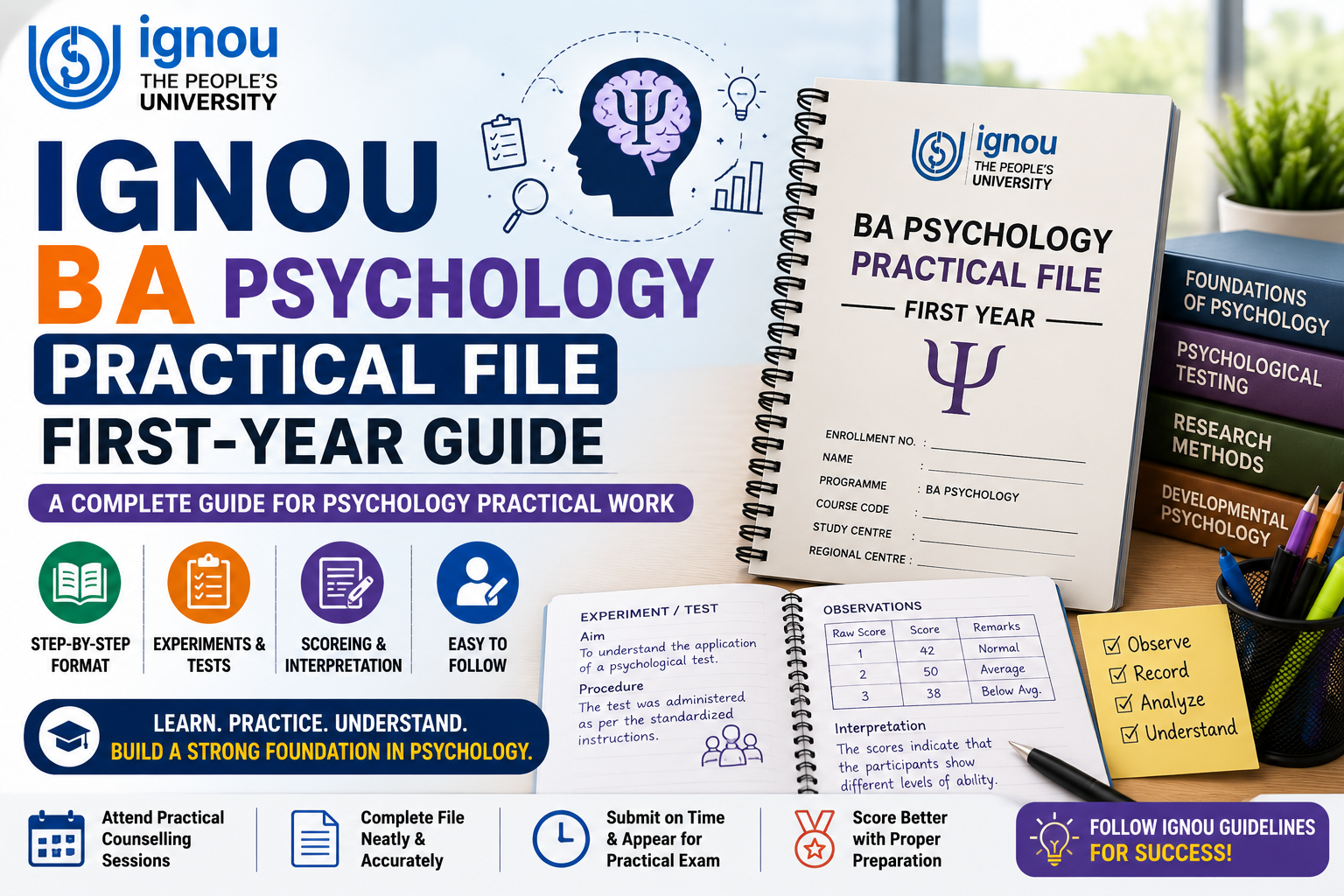
If you are wondering how to prepare your first IGNOU BA Psychology practical record, you might be confused about which experiments to include, how to write a psychological test report or if your work should be handwritten.
First of all, you need to know that IGNOU does not have a common first-year Psychology practical requirement for all the BA students. Depending on your program, course code and admission session, your instructions will differ.
Students admitted to the erstwhile BA General program with Psychology studied BPCC-131: Foundations of Psychology that had a practical component. IGNOU has a different course structure also, BA (Honours) Psychology, BAPCH. Its core courses in the first year are BPCC-101, BPCC-102, BPCC-103 and BPCC-104.
A practical file is intended to record the psychological tests, experiments or activities you have actually done. It should show that you understand the purpose, the method, the observations and interpretation of the work.
This guide will show you how to identify your practical course, organize the file, write a practical report and prepare for its evaluation.
1. Which IGNOU BA Psychology Students Need a Practical File?
Before preparing a file, check the exact programme and course listed in your registration details.
IGNOU has offered Psychology through different BA programme structures, and their course codes should not be treated as interchangeable.
| Programme or course | What students should check |
|---|---|
| BA General/BAG with Psychology | BPCC-131: Foundations of Psychology and its applicable practical instructions |
| BA (Honours) Psychology, BAPCH | Practical or tutorial requirements attached to the relevant core courses |
| BA General Psychology, BPCC-134 | A later-semester practical component in the earlier BAG structure |
| Other BA structures with Psychology | The course code and programme guide applicable to the admission session |
IGNOU's official BAPCH programme information states that its core courses include either practical or tutorial work worth two credits.
However, the type of assessment is linked to the individual course.
A student should not assume that every first-year Psychology paper requires a separate laboratory practical file.
Why Your Course Code Matters
Imagine you find a practical file sample on the internet called BPCC-131.
That file is a particular Psychology course under the BA General structure.
In BAPCH, if your course is BPCC-101, you should not automatically be using the BPCC-131 file as your submission format.
Both courses cover Psychology but they may not have the same required activities and assessments.
The best place to start is by checking the course handbook and instructions given to you by your learner support center.
2. What Is a Psychology Practical Record?
A Psychology practical record documents work done as part of the course.
It may contain psychological tests, experiments, observations, calculations, interpretations and references depending on the work prescribed.
A psychological test report, for example, will often have a description of what the test measures, how it was administered, and what the scores mean in relation to the scoring system used for the test.
A practical file in Psychology is not like a normal theory assignment.
Assignments usually respond to questions set out in the course assignment booklet.
A practical report is a report on an activity or assessment procedure. It tells what was actually done.
This distinction is important because a good theory response does not, by itself, prove that a practical procedure was carried out.
3. What Should You Include in the First-Year Practical File?
The exact arrangement must follow your course's handbook or counsellor instructions.
However, the following structure is a useful way to organise a psychology practical record.
| File component | Purpose |
|---|---|
| Cover page | Identifies the student, course and learner support centre |
| Table of contents | Shows the activities and their page numbers |
| Practical title | Names the test, experiment or activity |
| Aim | States what the activity is intended to examine |
| Introduction | Explains the relevant psychological concept |
| Materials or test details | Identifies the approved materials used |
| Participant information | Records necessary non-identifying information |
| Procedure | Explains how the activity was conducted |
| Observations or responses | Records the information collected |
| Scoring and calculations | Shows how results were obtained, where applicable |
| Interpretation | Explains the findings within the test's limits |
| Conclusion | Summarises what the activity demonstrates |
| References | Acknowledges sources used in preparing the report |
Not every activity needs every heading.
For example, a written analysis of an educational video may not require a psychological scoring table. A psychological test report, on the other hand, may require scoring and interpretation.
Follow the instructions for the actual activity rather than filling every heading mechanically.
4. How to Make the Cover Page of Your IGNOU Practical Record
The cover page should clearly identify whose work is being submitted.
IGNOU's January 2022 BPCC-131 practical instructions specified the course code, enrolment number and learner support centre in the practical report.
An organised cover page can also include your name, programme and academic session.
Suggested Cover Page Format
IGNOU BA Psychology Practical File
Student Name: [Your name]
Enrolment Number: [Your enrolment number]
Programme: [Your registered BA programme]
Course Code: [Your practical course code]
Course Title: [Official course title]
Academic Session: [Applicable session]
Learner Support Centre: [Centre name and code]
Regional Centre: [Regional centre]
This is a suggested layout, not a university-issued cover-page template.
If your programme handbook or academic counsellor provides a different format, use that format instead.
5. How to Write a Psychology Practical Report
The most important part of the file is the individual practical report.
A good report is specific. It should explain the purpose of the activity, describe the method used and distinguish observed results from interpretation.
Step 1: Write the Title and Aim
Begin with the name of the assigned experiment, test or activity.
The aim should state what is being studied.
For example, a practical involving an approved memory task might examine recall performance under a specified set of conditions.
The precise wording should reflect the practical you were actually assigned.
Step 2: Explain the Psychological Concept
Introduce the theory or concept relevant to the activity.
If the practical concerns memory, explain the particular memory process being investigated.
If it involves a personality assessment, discuss the construct measured and the theoretical background of the test.
Avoid adding several pages of unrelated textbook definitions merely to increase the length of the file.
Step 3: Describe the Method
Record the approved materials, instructions and procedure.
The procedure should make clear what was actually done and in what order.
If the activity involves a participant, describe only the relevant characteristics permitted by your course instructions.
Use non-identifying descriptions wherever possible.
Step 4: Present the Observations
Record the information collected during the practical.
Depending on the activity, this might include responses, task scores, observation notes or a calculation table.
Do not invent observations to make the report appear complete.
If a task could not be performed as assigned, seek guidance from your academic counsellor.
Step 5: Explain Scoring and Interpretation
Where a test includes a prescribed scoring method, use that method.
For example, a score may need to be calculated from individual responses and interpreted using the appropriate test norms.
Avoid treating the score as a medical diagnosis or making claims that the test cannot support.
The interpretation should explain what the result means within the scope of the educational activity.
Step 6: Write the Conclusion
Conclude with a brief explanation of what the practical showed.
Distinguish the observed findings from any broader claims about human behaviour.
If the activity had important limitations, mention them.
Step 7: Add References
List the sources you actually consulted.
IGNOU's historical BPCC-131 instructions specified APA seventh-edition referencing for additional materials used in practical reports.
Check whether your current course uses the same format.
6. Practical Examples from IGNOU BPCC-131
IGNOU issued special guidelines dated 15 January 2022 for online practical activities in the BA General Psychology courses BPCC-131 and BPCC-134.
Those guidelines were designed for specified older admission cycles and the December 2021 and June 2022 examination periods.
They provide useful examples of how Psychology practical activities can be documented, but they are not a universal practical list for current students.
Example 1: Personality Test Activity
In the history of BPCC-131, the instructions included an educational activity on Cattell's theory of personality.
The task was to get to know the test and to give the required assessment with the help of an academic counselor.
The resulting report called for some description of administration and interpretation.
The exercise further stressed the value of building rapport with the participant and ensuring that the responses are kept confidential.
This means that a Psychology practical report is more than simply writing the name of a test and calculating a score.
Students need to know what is being measured and must be administered according to the approved procedure.
Example 2: Operant Conditioning Activity
The same historical guidelines included an activity based on a video about operant conditioning.
Students were required to explain concepts such as reinforcement and behavioural learning in response to specific questions.
Unlike a psychological test, this activity was primarily explanatory.
It demonstrates why a single rigid report format may not suit every practical task.
Some activities require observations or scoring, while others require a structured explanation of a psychological concept.
Important Distinction
Do not copy these two examples into your current file unless they are part of the instructions issued for your course.
Your learner support centre or current course handbook determines the activities you need to complete.
7. Should the IGNOU Practical Record Be Handwritten or Typed?
There is no sound basis for claiming that every IGNOU BA practical record must always be handwritten.
The format depends on the applicable instructions.
For example, IGNOU's January 2022 online practical guidelines included provisions for reports in typed or handwritten form, although the specific psychological-test activity also described a typed document requirement.
Those were session-specific arrangements.
For your current work, confirm the required format with the appropriate academic counsellor.
If Handwriting Is Required
Write legibly, use consistent headings and leave enough space for tables and observations.
Number the pages so the evaluator can locate each practical easily.
If Typed Reports Are Permitted
Use a readable font, consistent spacing and clearly labelled tables.
Make sure the document remains organised when printed or converted into an accepted submission format.
Neither neat handwriting nor attractive formatting compensates for incomplete practical work.
8. How Many Practical Experiments Are Required in First Year?
The amount of practical work is not universal.
Depending on the course, academic session and relevant instructions.
The special January 2022 BPCC-131 guidelines detailed the specific activities for the affected learners.
They didn’t set a permanent experiment count for all future BA Psychology batches.
Similarly, BAPCH students should follow the practical or tutorial requirements attached to their own first year courses.
Don’t just take a random number of experiments from an online sample file.
Use the list given in the relevant course material or by the authorized academic counselor.
9. How to Protect Participant Information in Your Practical File
Some psychology practicals ask you to collect data about another person.
Even in an undergraduate learning activity, it is necessary to handle that information with care.
Explain the purpose of the activity, follow the counsellor’s instructions and get appropriate consent from the participant.
Do not log personal information that is unnecessary such as full addresses, identification numbers or private contact information.
If the approved report needs demographic information, just include the requested information.
For example, educational reports may need an age category or relevant background information, but not the participant’s full name.
Responses to tests should not be shared publicly.
Psychological tests have their limits, too. A first year student is not qualified to diagnose a mental health condition and give a professional psychological assessment - it’s a classroom exercise.
10. How Is the IGNOU BA Psychology Practical Work Evaluated?
Evaluation arrangements depend on your course and academic session.
The January 2022 special guidelines for BPCC-131 and BPCC-134 described an assessment worth 100 marks.
| Assessment component | Marks in the historical guidelines |
|---|---|
| Internal assessment based on the practical report | 50 |
| External assessment through viva voce | 50 |
| Total | 100 |
The same notice described a consolidated passing percentage of 35%.
However, these details applied to specific older examination sessions. They should not be treated as the current evaluation structure for every BA Psychology programme.
Consult the applicable programme guide and practical examination instructions to confirm the present requirements.
What Might an Evaluator Look For?
A practical evaluator may examine whether you understand the psychological concepts, have completed the required activity and can explain the procedure.
An organised report also makes it easier to follow your observations and interpretation.
When the prescribed evaluation includes a viva, the examiner may assess your understanding through questions about the practical work.
Simply memorising a report may not prepare you to answer those questions.
11. How to Prepare for the Psychology Practical Viva
The purpose of viva preparation is to understand the work documented in your file.
You should be able to explain what you did rather than recite a memorised answer without understanding it.
Depending on the practical, useful preparation questions include:
- What was the aim of the experiment?
- Which psychological concept was being studied?
- Why was the particular test or method used?
- What instructions were given to the participant?
- How were the observations recorded?
- How was the score calculated?
- What did the results indicate?
- What limitations affected the activity?
- Why is confidentiality important in psychological testing?
These are suggested revision questions, not an official or guaranteed IGNOU viva question list.
If you used a statistical calculation, practise explaining the relevant formula and what the result represents.
If you performed a psychological test, understand its purpose and the boundaries of its interpretation.
12. Where and When Should You Submit the Practical File?
Practical-file submission arrangements may differ between various programs, sessions and learner support centers.
Your center may tell you where the record should be submitted or produced for assessment.
Some of the courses may also have scheduled practical counseling sessions and separate instructions on examination.
Don’t assume that the date for submitting a theory assignment is the deadline for your practical report.
Before the appropriate assessment, ensure you are aware of the required file format, the submission location, the timetable and any registration or examination procedures.
Where instructions are unclear, contact the learner support centre or your programme's academic authorities.
13. Common Mistakes in IGNOU BA Psychology Practical Reports
A well-prepared file should represent completed practical work accurately.
Some common problems are worth avoiding.
Copying a File from Another Programme
A BPCC-131 file may not match a BAPCH course's requirements.
Always check the course code and applicable practical list.
Writing Results Without Conducting the Activity
A practical report should document real observations or properly completed educational activities.
Inventing scores or participant responses undermines the purpose of practical learning.
Omitting Scoring Details
Where scoring is prescribed, include the method used to calculate the result.
A final number without sufficient explanation may make the report difficult to assess.
Overstating Psychological Conclusions
A classroom personality activity should not be presented as a clinical diagnosis.
Explain only what the approved method and findings support.
Ignoring Current Centre Instructions
Historical practical guidelines can help explain report structure, but they may not describe the requirements for your examination session.
Leaving the File Until the Last Moment
Some activities require counsellor guidance, participant arrangements or access to prescribed materials.
Preparing the file in stages can make it easier to complete the required work properly.
14. Where to Find Official IGNOU Psychology Practical Instructions
The most useful information comes from the programme and course materials applicable to your registration.
Students can refer to these official resources:
- IGNOU BA (Honours) Psychology programme information — for BAPCH course structure and programme information.
- IGNOU eGyanKosh — for available self-learning materials, including Psychology course resources.
- IGNOU January 2022 Psychology Practical Guidelines — an example of practical instructions issued for specified older BAG batches.
The January 2022 notice should be used as a historical reference, not as automatic confirmation of current experiments, file length or examination arrangements.
For the final list of activities and the accepted submission format, follow your applicable course handbook and official learner support centre instructions.
Frequently Asked Questions
1. Is a practical file compulsory in IGNOU BA Psychology first year?
It depends on your programme and prescribed practical or tutorial requirements. Some Psychology courses include compulsory practical components, but the same requirement does not automatically apply to every first-year BA course.
2. What is the course code for the IGNOU BA Psychology first-year practical?
In the earlier BAG structure, BPCC-131: Foundations of Psychology included a first-semester practical component. BAPCH follows a different course structure, so students should confirm their own registered course code.
3. Can I prepare the IGNOU Psychology practical report at home?
You may be able to prepare the written report at home, but prescribed activities, test administration and counselling requirements must be followed. Do not assume that all practical work can be completed independently.
4. How many pages should the practical file contain?
There is no single page count established for every first-year Psychology course. A historical January 2022 notice prescribed approximately two to four pages for its special online activity report, but that limit should not be applied automatically to current practical files.
5. Can I submit a typed Psychology practical report?
Typed reports may be accepted where the applicable instructions permit them. Confirm the required format with your academic counsellor rather than assuming that either typed or handwritten work is universally allowed.
6. Does the Psychology practical record include experiments?
It may include experiments, psychological tests or other approved activities, depending on the course. Use the practical list specified for your programme.
7. Is there a viva for IGNOU BA Psychology practicals?
Some practical assessments include a viva. IGNOU's January 2022 BPCC-131 guidelines included external viva evaluation, but students should verify the arrangements for their own session.
8. Can I use an online Psychology practical-report sample?
You can study a sample to understand report organisation, but it should not replace prescribed activities or your own work. Check that its course code and format match your applicable instructions.
Final Words
If you start with the right course code and practical handbook, it is easier to prepare your IGNOU BA Psychology practical record.
You are not trying to fill a certain amount of pages. It precisely describes the psychological activities that are necessary, makes clear observations, and discusses the results in their limitations.
Students in BAG, BAPCH and other BA structures should not assume that they all have the same first-year practical requirements.
Before you begin the file, consult your learner support center about the prescribed activities, format and submission procedure.
A practical record should be helpful in showing what you actually did, how you did it and what you learned from the activity.