 © Copyright 2026 IGNOU Galaxy.

Jobs After a Diploma in Horticulture From IGNOU
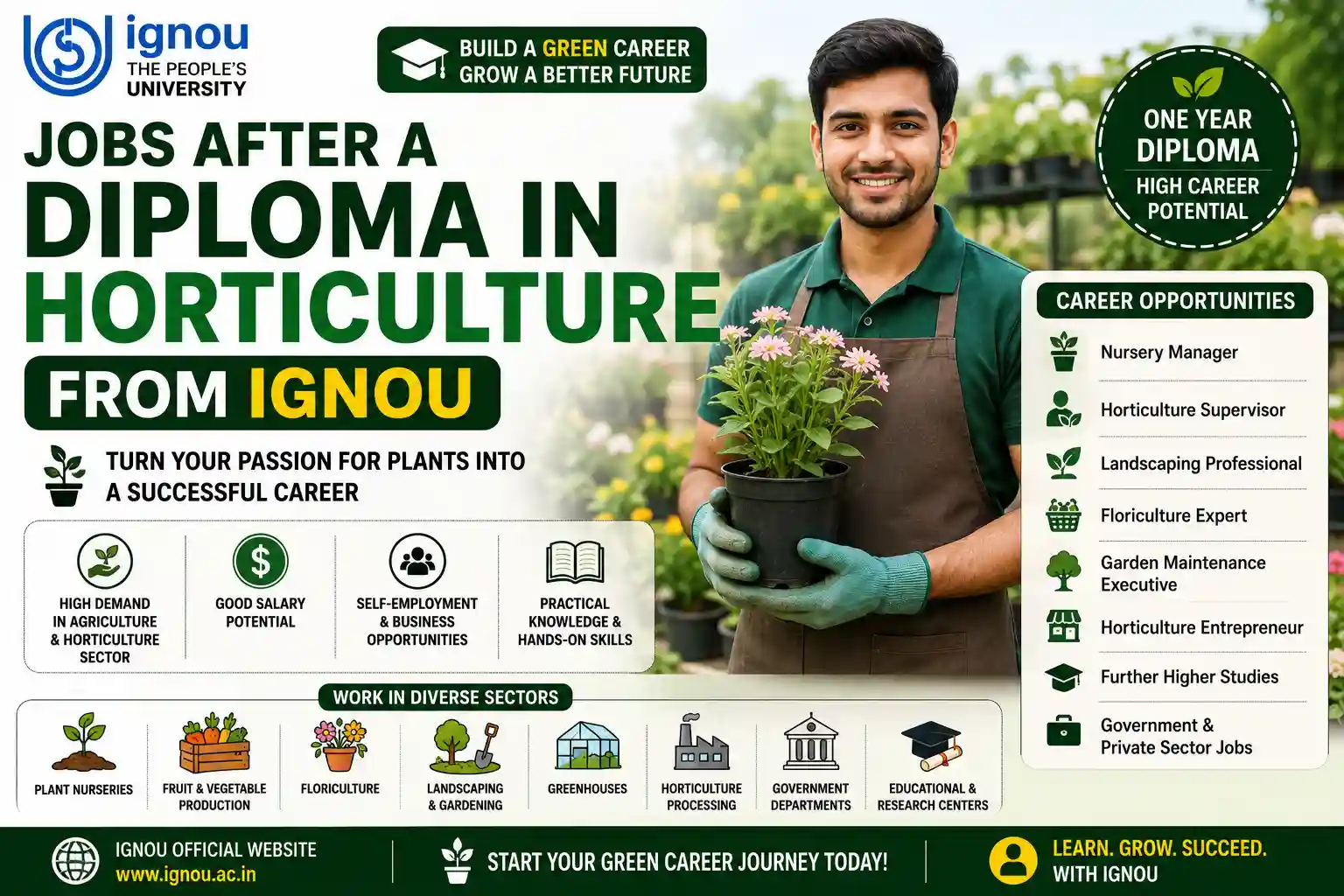
Indira Gandhi National Open University (IGNOU) Diploma in Horticulture can help students discover careers in plant cultivation, nursery management, landscaping, fruit production and vegetable farming.
Horticulture is a field of practice. Employers often seek out people who can grow healthy plants, recognise common growing problems and manage nursery operations and maintain gardens or landscaped areas.
A commercial nursery, for example, may need someone who knows how to propagate plants and care for seedlings. Landscaping companies may need workers who can tend to lawns, ornamental plants and irrigation systems.
Graduates after completing Diploma in Horticulture from IGNOU can join entry level jobs in nurseries, landscaping companies, horticultural farms, gardening services and plant production businesses. They can also look into self-employment.
But the diploma does not guarantee placement or automatically qualify the graduates for all the government horticulture posts.
This article examines realistic career prospects, the work that might be involved in each job, the skills that employers might be looking for and ways that graduates can progress their careers.
What Is IGNOU's Diploma in Horticulture?
IGNOU, through the School of Agriculture, offers Diploma in Horticulture under Open and Distance Learning (ODL).
It introduces students to the cultivation of fruits, production of vegetables, floriculture, plant propagation, nursery management and landscape designing.
According to IGNOU's official program information, the diploma is aimed at developing skills in Gardening, Supervisory work, middle-level technical activities and horticultural entrepreneurship.
The program length published is a minimum of one year and a maximum of three years. Eligibility : Class 12 or equivalent.
The program includes practical learning activities that are particularly relevant for students preparing for work in the field.
Students can review the subjects and programme objectives on the official IGNOU Diploma in Horticulture page.
Career Options After IGNOU Diploma in Horticulture
The diploma can be relevant to different types of horticultural employment.
| Job role | Main responsibilities | Possible workplaces |
|---|---|---|
| Nursery Assistant | Plant propagation, watering and seedling care | Commercial nurseries |
| Garden Supervisor | Organising garden maintenance activities | Landscaping firms, institutions |
| Horticulture Field Assistant | Supporting cultivation and field operations | Horticultural farms |
| Floriculture Assistant | Growing and maintaining ornamental flowers | Flower farms, nurseries |
| Landscape Maintenance Assistant | Maintaining lawns, shrubs and planted areas | Residential complexes, hotels |
| Vegetable Production Assistant | Supporting vegetable cultivation | Vegetable farms, protected cultivation units |
| Grafting and Propagation Worker | Preparing grafts, cuttings and young plants | Fruit nurseries |
| Nursery Entrepreneur | Producing and selling plants | Self-owned nursery business |
These are possible occupational pathways, not a list of jobs reserved for IGNOU diploma holders.
Actual eligibility depends on the vacancy, employer requirements, relevant experience and practical abilities.
1. Nursery Assistant or Nursery Worker
Working in a plant nursery is one of the more directly relevant career options for a horticulture diploma holder.
Nurseries raise seedlings, ornamental plants, fruit saplings and other planting material for sale or transplantation.
A nursery assistant may be responsible for preparing growing media, filling containers, sowing seeds, watering plants and maintaining a suitable growing environment.
Other responsibilities can include identifying unhealthy plants, organising stock and preparing plants for customers.
Skills Required
Nursery employers may value knowledge of seed germination, potting mixtures, watering schedules and plant propagation.
For example, different plants need different growing conditions. Excessive watering can damage roots, while insufficient moisture can prevent proper growth.
A worker who understands these differences can contribute to better nursery management.
Career growth: With experience, nursery assistants may progress toward supervisory responsibilities, stock management or independent nursery operations.
2. Garden Supervisor
A garden supervisor helps organise the maintenance of gardens, lawns and landscaped surroundings.
Such work may be available through private landscaping contractors, residential management services, educational institutions, commercial properties and hospitality businesses.
A supervisor may coordinate tasks such as pruning, watering, weeding, planting and seasonal maintenance.
For example, a large residential complex may require different maintenance schedules for lawns, flowering plants, trees and hedges.
The supervisor needs to identify the work required and ensure that maintenance activities are performed correctly.
Can a Fresher Become a Garden Supervisor?
Some employers may consider applicants with relevant horticultural training for junior supervisory positions.
However, many supervisory roles require practical experience in garden maintenance and managing workers.
A diploma can provide useful subject knowledge, but applicants should not assume that it automatically qualifies them for a senior position.
3. Horticulture Field Assistant
Horticulture field assistants assist with activities related to the production of fruit, vegetable or ornamental crops.
They could help with planting, irrigation, nutrient management, crop monitoring and harvesting.
A business that grows vegetables could ask employees to monitor plant growth, spot issues with watering, and maintain cultivation records.
The work is more hands-on than in an office, usually.
A field assistant may spend quite a bit of time outdoors or in protected cultivation structures.
Where Can You Look for Such Jobs?
Private horticultural farms, agricultural enterprises, nurseries and organisations implementing cultivation projects may employ field-level workers.
Job titles vary considerably between employers.
Some may advertise for a farm assistant or production assistant instead of using the term horticulture field assistant.
Applicants should examine the actual responsibilities and qualification requirements rather than relying only on the position title.
4. Floriculture Assistant
Floriculture is the art and science of growing and handling flowering and ornamental plants.
Floriculture and landscaping are covered in IGNOU's Diploma in Horticulture.
This can be useful for students interested in ornamental plant production, flower nurseries, and commercial flower growing.
A floriculture assistant may assist with planting, watering, maintaining plant health, harvesting flowers and preparing products for sale.
A business that grows flowers, for instance, may require workers who know about seasonal cultivation, plant spacing and the handling of flowers after they are picked.
But commercial floral arrangement and event decoration may require more design and customer-service skills than crop production.
5. Landscape Maintenance Assistant
Landscaping is the art and practice of creating and maintaining outdoor green spaces.
Potential employers include garden maintenance contractors, hotels, resorts, residential complexes, commercial properties and private institutions.
A landscape maintenance worker may work with lawns, shrubs, ornamental plants, trees, and simple irrigation systems.
The work could include soil preparation, pruning, planting, watering and general maintenance.
What Makes Landscaping Different From Nursery Work?
The nursery’s work is primarily the growing and care of plants until they are sold or transplanted.
Landscaping is the art of selecting, arranging and maintaining plants in a given area.
For example, a hotel garden has to be looked after for looks, plant health, seasonal growth and practical use of outdoor space.
Students interested in landscaping may find it useful to learn basic site planning, irrigation maintenance and plant identification along with their diploma studies.
6. Fruit and Vegetable Production Assistant
Fruit and vegetable farming is another area connected to IGNOU's horticulture curriculum.
The diploma includes subjects covering the production technology of fruit and vegetable crops.
These areas can help graduates understand crop establishment, plant care and basic cultivation practices.
An assistant working on a fruit farm may help with orchard maintenance, pruning, irrigation and harvesting.
In vegetable production, responsibilities may include raising seedlings, transplanting, maintaining growing conditions and observing plant health.
Opportunities in Protected Cultivation
Some horticultural enterprises use polyhouses, net houses or other protected cultivation structures.
These environments require attention to temperature, humidity, irrigation and crop management.
The diploma can provide a foundation, but specialised protected cultivation work may require additional practical training.
Students interested in this field should seek opportunities to work with functioning cultivation units.
7. Plant Grafting and Propagation Worker
Plant propagation is one of the most practical areas of horticulture.
It involves producing new plants through seeds or vegetative methods such as cuttings, budding and grafting.
IGNOU's programme includes a dedicated course on Plant Propagation and Nursery Management.
A worker with these skills may find opportunities in fruit-plant nurseries and commercial propagation units.
For example, a nursery producing grafted fruit plants needs workers who can perform grafting correctly and care for young plants during establishment.
Why Is Practical Experience Important?
Grafting requires accuracy and an understanding of plant growth.
Knowing the theoretical steps is different from performing them successfully on living plants.
Students who practise grafting under experienced nursery workers can develop a more useful skill set for employment.
A portfolio showing successful propagation work may also help demonstrate practical ability to potential employers.
8. Can You Get a Government Job After IGNOU Diploma in Horticulture?
You can apply for Horticulture jobs in the government sector only in those places where the recruitment notification accepts your qualification.
Departments and organisations may advertize posts in gardening, nursery work, horticultural maintenance or field support.
But many technical and officer-level horticulture jobs require a recognised Bachelor degree in Horticulture, Agriculture or another specified discipline.
Some positions may also require experience, vocational qualifications, trade certificates or other eligibility criteria.
An IGNOU Diploma in Horticulture shouldn't be taken as a replacement for a B.Sc. Horticulture degree.
Which Government Job Requirements Should You Check?
Before applying, examine the official recruitment notice for:
- Essential educational qualifications.
- Accepted diploma or degree disciplines.
- Required practical experience.
- Age limits and applicable relaxations.
- Recruitment examinations or skill tests.
- Any specific recognition or training conditions.
Do not rely solely on websites that publish lists of horticulture jobs without reproducing the relevant eligibility conditions.
Government vacancies are not guaranteed simply because IGNOU offers the programme.
9. Can You Start Your Own Business After the Diploma?
Self-employment may be particularly relevant for students who have access to a small plot, existing nursery facilities or experience in plant cultivation.
IGNOU identifies entrepreneurship development as one of the objectives of its Diploma in Horticulture.
Graduates may consider small horticultural enterprises based on their resources and practical skills.
Small Plant Nursery
A nursery can focus on ornamental plants, seasonal flowers, fruit saplings or vegetable seedlings.
Starting on a limited scale may allow the owner to understand local demand before expanding production.
For example, a small nursery could supply vegetable seedlings to nearby home gardeners and farmers.
Successful operation requires more than producing plants. The owner must also manage costs, plant losses, sales and customer relationships.
Home Gardening and Maintenance Services
Graduates with gardening skills may offer planting and maintenance services to households or local properties.
Services could include preparing garden beds, selecting suitable plants, pruning and routine maintenance.
The business may require tools, transport and an understanding of customer requirements.
Grafting and Sapling Production
Someone experienced in fruit-plant propagation may specialise in producing suitable planting material.
This requires reliable plant sources, proper nursery practices and attention to plant health.
Depending on the location and nature of the business, applicable nursery registration or other regulatory requirements may need to be checked.
Kitchen Gardening Services
Some households and institutions want to grow vegetables in available outdoor spaces.
A horticulture-trained individual may help with basic bed preparation, seasonal crop selection, watering plans and maintenance.
This can be explored as a local service business, although demand and earning potential will vary by location.
10. What Salary Can You Expect After an IGNOU Diploma in Horticulture?
There is no single verified salary applicable to every IGNOU Diploma in Horticulture graduate.
Pay varies according to the employer, job location, role, prior experience and responsibilities.
A nursery assistant, for example, may receive different compensation from someone employed as an experienced garden supervisor.
Similarly, wages in a small local nursery may differ from pay offered by a large landscaping contractor.
| Career level | What generally affects earnings |
|---|---|
| Entry-level nursery or garden worker | Local wages, employer size and basic skills |
| Skilled grafting or propagation worker | Demonstrated technical ability and experience |
| Garden supervisor | Team responsibilities, experience and project scale |
| Horticulture field assistant | Type of agricultural enterprise and duties |
| Self-employed nursery operator | Sales, expenses, plant survival and customer demand |
Self-employment income is especially difficult to predict.
A nursery business may generate sales without making a profit if plant losses, transport or operating costs are high.
For reliable salary expectations, compare current vacancies for the exact role and location rather than relying on an average figure that may not reflect available jobs.
11. Which IGNOU Horticulture Subjects Are Useful for Employment?
The programme's curriculum is closely connected to practical horticultural activities.
The official programme page lists subjects covering the following areas.
| IGNOU course | Main area of learning | Potential workplace application |
|---|---|---|
| BAP-002: Basic Horticulture | Fundamentals of horticulture | General nursery and garden work |
| BAPI-004: Production Technology of Fruit Crops | Fruit cultivation | Orchards and fruit nurseries |
| BAPI-005: Production Technology of Vegetable Crops | Vegetable cultivation | Vegetable farms and seedling units |
| BAPI-006: Floriculture and Landscaping | Ornamental plants and landscaping | Flower farms and garden maintenance |
| BAPI-007: Plant Propagation and Nursery Management | Propagation and nursery practices | Commercial nurseries and grafting units |
The course list is published by IGNOU, but job applications still depend on the employer's requirements.
Students should connect their coursework with practical experience wherever possible.
For example, someone interested in nursery management should spend time learning about potting media, propagation methods, plant identification and stock maintenance.
A student planning to work in landscaping may benefit more from observing commercial garden maintenance activities.
12. How to Improve Your Job Prospects After the Diploma
Completing the diploma establishes that you have studied the prescribed programme, but practical employment often requires evidence of what you can do.
Build Hands-On Experience
Try to gain experience at a nursery, horticultural farm or landscaping business.
Even limited practical exposure can help you understand workplace responsibilities.
For example, learning how to recognise watering problems or handle young plants can be useful in an entry-level nursery role.
Develop One Specialised Skill
Instead of trying to become an expert in every horticultural activity immediately, begin with a skill connected to your preferred career.
This could be plant grafting, vegetable seedling production, ornamental plant care or garden maintenance.
A clearly demonstrated skill can make it easier to explain your value during an interview.
Keep Records of Practical Work
Maintain photographs and brief records of cultivation activities you have completed.
For instance, a nursery-focused portfolio could show plant propagation attempts, the methods used and the outcome.
Avoid presenting unsuccessful or incomplete work as professional experience.
Learn Basic Business Operations
Students interested in self-employment should understand how to calculate production costs, maintain records and assess customer demand.
A successful nursery must manage inventory, plant losses and seasonal sales alongside horticultural work.
Search for Related Job Titles
Do not search only for vacancies labelled “Diploma in Horticulture”.
Relevant positions may use titles such as nursery assistant, garden maintenance worker, farm assistant, plant propagation worker or landscaping assistant.
Read the responsibilities and eligibility conditions of each vacancy carefully.
13. Can You Pursue Further Studies After the Diploma?
Further education is available for students who wish to be qualified for a broader range of technical or professional jobs.
Further admission is, however, subject to the eligibility rules of the intended institution and program.
For example, admission to Bachelor’s degree in Horticulture or Agriculture may have specific Class 12 subjects and other criteria.
An IGNOU horticulture diploma does not guarantee lateral entry or exemptions to a bachelor’s program.
Students interested in nursery entrepreneurship may also choose further training in plant propagation, protected cultivation, farm management or marketing.
For those specifically interested in post-harvest activities, IGNOU separately offers a Diploma in Value Added Products from Fruits and Vegetables. This is a different programme focused on processing and value addition rather than general horticultural production.
Is the IGNOU Diploma in Horticulture Worth It for Jobs?
It is contingent upon the career path you want to pursue.
The diploma could be useful for someone wanting to enter nursery work, horticultural services, fruit or vegetable production or a small horticultural business.
It can also help existing nursery workers and gardeners to consolidate their understanding of horticultural practices.
However, those who are mainly aspiring to become government horticulture officers should first check the recruitment notifications. If the job you want requires a four-year degree, that diploma alone may not cut it.
Similarly, those who expect to get an automatic high-paying managerial job after a one-year diploma may have to revise their expectations.
The program should be seen primarily as a basis for practical horticultural skills and selected entry-level or self-employment opportunities.
Frequently Asked Questions
1. Can I get a job after IGNOU Diploma in Horticulture?
You can apply for relevant entry-level positions in nurseries, gardening services, landscaping businesses and horticultural farms. Selection depends on employer requirements, practical skills and available vacancies.
2. What are the best job options after this diploma?
Nursery assistant, plant propagation worker, garden maintenance assistant and horticulture field assistant are among the more directly related options. The most suitable role depends on your interests and experience.
3. Is IGNOU Diploma in Horticulture valid for government jobs?
Eligibility depends on the recruitment notification. Some positions may accept a relevant diploma, while others require a specific degree, vocational qualification or experience.
4. Can I become a horticulture officer after this diploma?
The diploma alone should not be assumed sufficient. Horticulture officer positions commonly specify degree-level qualifications and other recruitment conditions. Check the particular vacancy notice.
5. Can I start a nursery after completing the diploma?
Yes, a small nursery is a possible self-employment option. However, business success depends on practical ability, available resources, local demand, operating costs and applicable requirements.
6. Does IGNOU provide placement after Diploma in Horticulture?
The official programme description identifies possible careers, but it does not establish a guaranteed placement arrangement for diploma graduates.
7. Can I work in a landscaping company?
You can seek relevant entry-level landscaping and garden maintenance positions. Employers may require experience, plant knowledge and practical maintenance skills.
8. Is practical training important for horticulture jobs?
Yes. Skills such as plant propagation, irrigation, pruning, nursery management and crop care are best developed through hands-on work alongside theoretical study.
Final Words
The Diploma in Horticulture from IGNOU can be a good starting point for careers involving nursery operations, gardening, landscaping and crop production.
It is more associated with practical, field-based work and small horticultural enterprises rather than automatic access to professional officer level positions.
Students who combine the diploma with practical experience in plant cultivation or nursery operations would be better placed to compete for relevant vacancies or to start up their own services.
Decide what kind of work you want to do and verify the qualifications employers really want before you settle on a career.