 © Copyright 2026 IGNOU Galaxy.

Home › Guides › IGNOU results › Passing marks
IGNOU Passing Marks: How Much Do You Need to Pass, and How Is Your Score Worked Out?
RJBy Ranjeet Kumar Jha, Head of Operations, IGNOU Galaxy
Updated 12 November 2026 · 7 min read
There isn't one IGNOU passing mark for every programme. Two programmes can share the same 30:70 split between assignment and exam and still pass students in different ways. This guide sets out the pass rules printed in seven IGNOU programme guides, works through examples, and ends with a calculator you can set to your own programme's rule. Your own programme guide has the final word for your course.
How is an IGNOU course score worked out?
For many theory courses, the assignment carries 30% and the term-end exam 70%. Both the BCOMF guide and the MBA handbook state this split. To find a course score as a percentage:
Course score = (assignment % × 0.3) + (term-end exam % × 0.7)
If a paper is marked out of something other than 100, convert it to a percentage first. For example, 28 out of 50 is 56%.
Not every course follows this split. A project is often assessed on the project report alone, and some courses have practicals or no assignment. Check your programme guide for your course's structure.
What does the BCOMF programme guide require to pass?
BCOMF is IGNOU's four-year B.Com Honours programme under UGC FYUP. Its guide requires at least 35% (grade D) in both the assignment and the term-end exam of each course, and says the two "are not complementary to each other for qualifying a course". A high mark in one can't make up for a low mark in the other. These rules are specific to BCOMF; don't assume they apply to another programme without checking its guide.
What does the MBA handbook require to pass?
The MBA Student Handbook says a student needs an overall C grade to qualify a course, on this five-point scale:
| Grade | Meaning | Percentage (as printed in the handbook) |
|---|---|---|
| A | Excellent | 80% and above |
| B | Very Good | 60% to 79.9% |
| C | Good | 50% to 59.9% |
| D | Satisfactory | 40% to 49.9% |
| E | Unsatisfactory | Below 40% |
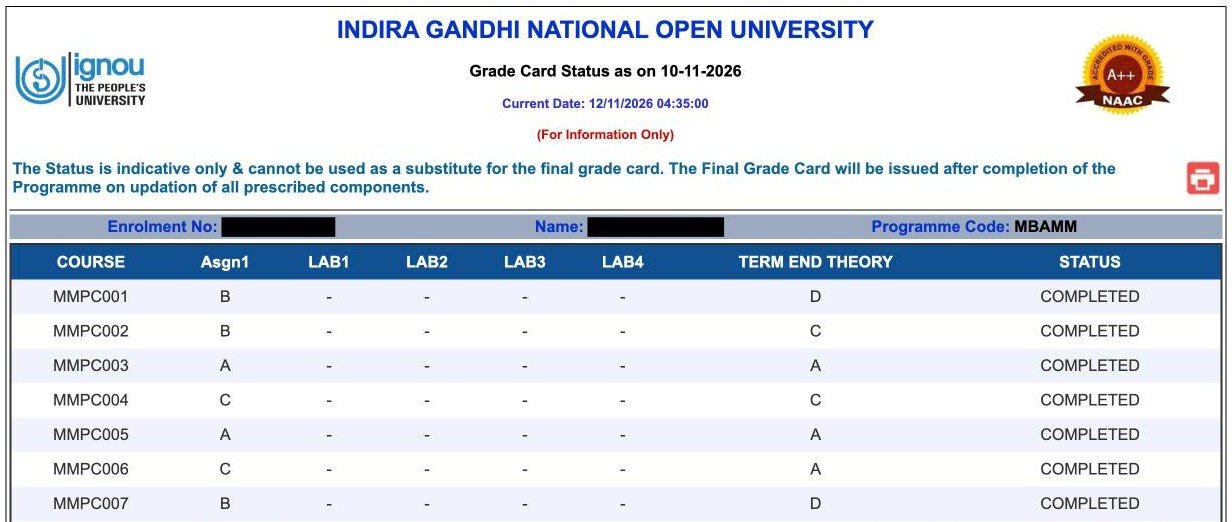
An overall C means a course score of at least 50%. Because the combined score counts, a weaker exam can be balanced by a stronger assignment. The grade card below is consistent with that, though letter grades alone don't reveal the exact marks behind them.
What do other IGNOU programme guides require?
We checked the evaluation sections of five more programme guides. Each rule below applies to that programme only; the calculator further down has each one as a preset.
| Programme (guide) | Assignment : term-end | Pass rule for a theory course |
|---|---|---|
| BSCM, four-year B.Sc multidisciplinary (programme guide) | 30 : 70 | At least 35% (grade D) in both parts; the parts are "not complementary to each other" |
| BCA_NEW (guide, May 2026) | 30 : 70 for most courses; 25 : 75 for some | At least 40% in the assignment and 40% in the term-end exam, each passed separately; a few courses listed in the guide use 35% |
| MCA_NEW (guide, July 2025) | 30 : 70 | At least 40% in the assignment, with its viva compulsory, and 40% in the term-end exam, plus an overall average of 40% |
| MLIS, Master of Library and Information Science (programme guide) | 30 : 70 | At least 40% in both continuous evaluation and the term-end exam; the project needs 50% |
| CFN, Certificate in Food and Nutrition (programme guide) | 30 : 70 | At least 35% in the term-end exam on its own; the guide mentions minimum qualifying marks for assignments without giving a figure |
In these guides, the four-year bachelor's and certificate programmes use 35%, the computer applications and library science programmes use 40%, and the MBA uses an overall 50%. Your own guide's rule is the one that counts, so look it up before relying on any figure.
What grade scale does IGNOU use for CBCS bachelor's programmes?
Para 1.17 of the July 2026 prospectus gives a ten-point scale for bachelor's programmes under CBCS. The BCOMF guide prints the same scale. The percentage column is shown here exactly as printed:
| Letter grade | Grade point | Percentage, as printed |
|---|---|---|
| O (Outstanding) | 10 | >85 |
| A+ (Excellent) | 9 | >75 to <85 |
| A (Very Good) | 8 | >65 to <75 |
| B+ (Good) | 7 | >55 to <65 |
| B (Above Average) | 6 | >50 to <55 |
| C (Average) | 5 | >40 to <50 |
| D (Pass) | 4 | >35 to <40 |
| F (Fail) | 0 | <35 |
| Ab (Absent) | 0 | Absent |
As printed, the table doesn't say which grade an exact boundary score such as 85% or 75% falls into. If your score sits exactly on a boundary, go by the grade shown on your grade card, and ask IGNOU if it looks wrong. This scale tells you the grade bands; your programme guide tells you the pass rule.
Worked examples: did this student pass?
These apply the formula and the two documented rules above. The marks are illustrative, chosen to show how each rule works.
| Example | Assignment | Term-end exam | Course score | Result |
|---|---|---|---|---|
| A. BCOMF | 62% | 48% | (62 × 0.3) + (48 × 0.7) = 52.2% | Pass: both parts are at least 35% |
| B. BCOMF | 80% | 30% | (80 × 0.3) + (30 × 0.7) = 45% | Not passed: the exam is below 35%, and the parts don't make up for each other |
| C. MBA | 70% | 44% | (70 × 0.3) + (44 × 0.7) = 51.8% | Pass: an overall 51.8% is a C |
| D. MBA | 60% | 42% | (60 × 0.3) + (42 × 0.7) = 47.4% | Not passed: an overall 47.4% is a D, below the C needed |
In examples C and D, both students have a B-range assignment and a D-range exam, yet one passes and one doesn't. That's how two courses with the same letter grades on a grade card can end up with different statuses.
What if your paper is marked out of 50?
Some papers are marked out of 50 rather than 100. A pass rule written as a percentage still applies, so convert first:
- 35% of 50 is 17.5. Where only whole marks are awarded, 18 is the first whole-number score above that threshold. Follow your programme's official pass and rounding rules.
- 40% of 50 is 20.
- 50% of 50 is 25. Under an overall-score rule like the MBA's, remember it's the weighted course score that counts, not the exam alone.
How do grades turn into a percentage or a division?
The prospectus says that for bachelor's and master's degrees IGNOU normally follows numerical marking, converts marks to grades, and "if required by the learner, the University provides numerical marks and division (I, II or Pass)." The BCOMF guide says numerical marks will appear on the grade card, with the division. If your grade card shows only letter grades and you need marks or a division for an application, ask the Student Evaluation Division through your Regional Centre.
If you are close to the next division, read about the improvement scheme and its conditions in our re-evaluation guide.
Course score calculator
Pick your programme to load the rule from its guide. If your programme isn't listed, choose Another programme and type in the weighting and minimums from your own programme guide; the calculator then works for any IGNOU programme that combines an assignment with a term-end exam.
Course score calculator
This works out one course's score, not your overall degree percentage. Practicals, projects and lab courses are assessed differently. The presets come from the guides listed under Sources; your own programme guide has the final word.
If your programme isn't one of the presets, its programme guide, on ignou.ac.in or eGyanKosh, states the rule in its evaluation section. Enter those figures under Another programme.
Sources checked 12 November 2026
- BCOMF Programme Guide 2025 (programme type, 30:70 weighting, 35% in each part, ten-point scale, marks and division on the grade card)
- MBA Student Handbook and Prospectus 2026 (30:70 weighting, overall C, five-point scale)
- IGNOU Common Prospectus, July 2026 (para 1.17 evaluation system and grade scales)
- BSCM Programme Guide (evaluation, 35% in each part)
- BCA_NEW Programme Guide, May 2026 (section 5, evaluation scheme)
- MCA_NEW Programme Guide, July 2025 (section 5, evaluation scheme)
- MLIS Programme Guide (evaluation)
- CFN Programme Guide (evaluation)
- IGNOU grade card portal, viewed 12 November 2026