 © Copyright 2026 IGNOU Galaxy.

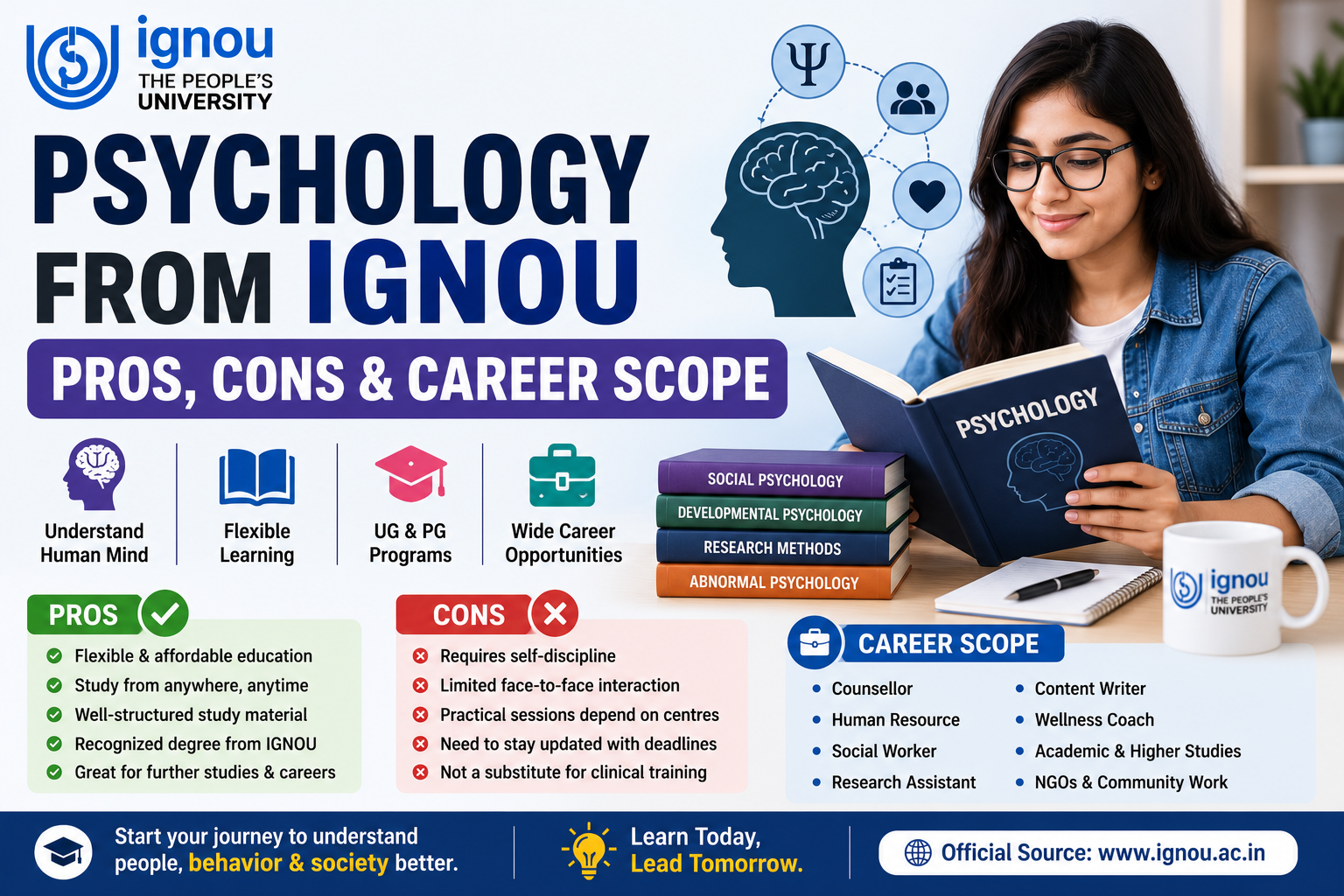
Psychology from IGNOU: Pros, Cons & Career Scope
Introduction
If you want to study human behaviour but still have work, family or other responsibilities, then psychology from IGNOU is a flexible option. Currently, IGNOU offers undergraduate psychology through programmes such as BAFPC and postgraduate study through MA Psychology, popularly known as MAPC.
The courses contain theory, assignments and practical components. However, students should also be aware that a general psychology degree does not automatically qualify students for all regulated clinical roles.
Level of IGNOU Psychology Course
BA Psychology IGNOU
The BAFPC programme is designed as per NEP 2020 framework integrating disciplinary, interdisciplinary and skill based courses. General Eligibility is 10+2 or equivalent.
Students may study topics including:
- Psychology general
- Social psychology
- Developmental psychology.
- Studies in psychology
- Applied and practical psychology
Older students might be registered under BAPCH or other previous programme structures so always check course codes.
MA Psychology IGNOU
The IGNOU MAPC course offers you an advanced study of psychological principles, research methods, assessment and applied areas. Normally entry is through a bachelor's degree of a recognised university.
The programme covers not only theory, but also practical work, internship and project components.
Advantages of Psychology at IGNOU
- Study schedule flexibility
- Low-cost distance learning format
- Printed and digital study material access
- Good for working learners
- Broad coverage of psychology topics
- Hands-on experience, internships and projects
- More opportunities for higher education
The official digital material of BAFPC is available in semester-wise collections on eGyanKosh. Students may also check the official IGNOU website and the ManualonStudentRegistration&EvalutionSystems.pdf.
Constraints and Difficulties
Realistically consider the pros and cons of IGNOU Psychology.
Possible obstacles include:
- Limited daily classroom contact
- Strong self-discipline is important
- Practical centres could be far Schedules in practice depend on Regional Centres
- Students are responsible for tracking deadlines.
- Internships may be self-arranged
- Distance study is not appropriate to learners who need regular supervision
Regional Centres publish separate practical-counselling and examination schedules so students should watch for local notices carefully.
Complete Your IGNOU Academic Journey
- Confirm admission and verify the program code.
- Keep the registration number.
- Download ID card IGNOU
- Programme guide Please read carefully.
- Get official study materials.
- Submit your assignments for the correct session.
- Attend compulsory practicals;
- Re-register for Tracks and Exam Deadlines.
- Fill up the Term-End Examination form separately.
- Completed internship, practical records and project work where applicable.
Generally, the students may be asked to consult IGNOU Galaxy. IGNOU Solved Assignments and IGNOU Handwritten Assignments are useful for assignment preparation. IGNOU Projects help students learn how to prepare projects. The university’s official guidelines should be the main source.
Job Opportunities After Pursuing Psychology From IGNOU
Entry-level and support positions are available for graduates in:
- Schools and student support services
- Community and NGO programmes
- Staffing and Human Resources
- Organisations providing social services and rehabilitation
- Survey and research work.
- Mental health awareness programmes
- Employee-wellness and training groups
- Academic content creation
Usually, an undergraduate degree is a foundation, not a professional specialisation. A master’s degree, supervised experience or additional training may be necessary for better opportunities.
Major Constraint of Clinical Practice
An IGNOU Psychology Degree is not a licence to practise as a clinical psychologist automatically. Qualifications and registration of clinical and rehabilitation psychology are regulated through recognised professional programmes and Rehabilitation Council of India requirements.
Students intending to enter regulated clinical practice should check the most recently approved qualifications before deciding on a career pathway.
Mistakes Not To Make
- Opting for psychology because it seems easy
- Neglecting statistical and research methods
- Not coming to practical counselling sessions
- Using the incorrect assignment session
- Practical records or projects copied
- Assuming MAPC alone ensures clinical registration
- Relying only on unofficial social-media advice
Students may also refer to IGNOU Guess Paper.
Commonly Asked Questions
1. Psychology Validity of IGNOU
Yes. Ignou provide recognised university courses but job eligibility depends upon employer and role.
2. Can I pursue psychology after class 12?
Yes. IGNOU BA Psychology Admission Eligibility Criteria
3. Can MAPC take people with any degree?
Usually a recognised bachelor's degree is accepted.
4. Does IGNOU psychology have practical work?
Yes. Psychology programmes have practical/practicum components.
5. Is attendance to practical sessions compulsory?
Attendance at relevant practical sessions is generally compulsory as per centre instructions.
6. After BA Psychology, can I become a psychologist?
A BA gives you the fundamentals. Advanced or regulated roles usually need further qualifications.
7. Can MAPC graduates be employed as counsellors?
Depending on their competence, training and the needs of the employer, they may seek to take on appropriate counselling-support roles.
Conclusion
Psychology at IGNOU is flexible, has structured study material and provides a gateway into education, research, counselling support, HR and community services.
Its biggest disadvantage is that distance learning requires practical planning and self-discipline. Students must match the degree with their career goal and check for professional requirements before engaging in clinical or regulated practice.