 © Copyright 2026 IGNOU Galaxy.
Best Books to Pass Your IGNOU Master’s Degree in Economics
Introduction
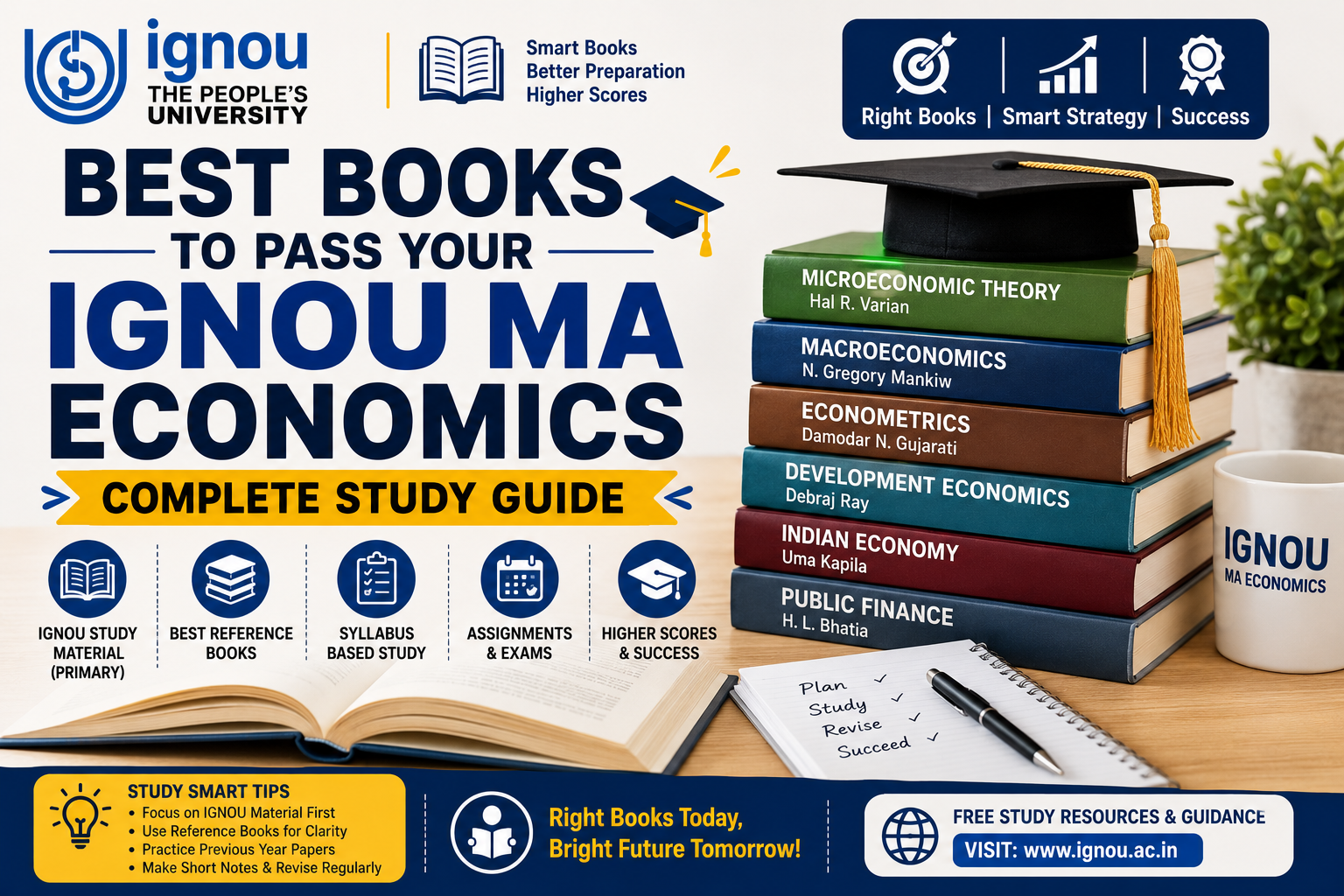
The Best Books for IGNOU MA Economics are the official IGNOU self-learning materials supported by a small number of standard reference books. Students do not need to purchase many expensive textbooks because the Term-End Examination is closely connected to the prescribed syllabus and study blocks.
The MA Economics programme develops theoretical, quantitative and applied economic-analysis skills. Its study material is organised course-wise and semester-wise, making it easier for distance learners to prepare systematically.
Start with Official IGNOU Study Material
Your first and most important resource should be the IGNOU MEC Study Material. The study blocks explain concepts in a distance-learning format and usually include examples, summaries, exercises and self-assessment questions.
Students can access official digital material through IGNOU’s online learning resources. The material covers microeconomics, macroeconomics, quantitative methods, growth, development and Indian economic policy.
Use the official IGNOU website to confirm the current MA Economics course structure, programme guide and academic instructions.
Best Books for Core Economics Subjects
Microeconomics
- Intermediate Microeconomics by Hal R. Varian
- Microeconomic Theory by Mas-Colell, Whinston and Green
- Modern Microeconomics by A. Koutsoyiannis
Varian is suitable for conceptual clarity, while Mas-Colell is more advanced. Beginners should understand the IGNOU blocks before moving to difficult mathematical texts.
Macroeconomics
- Macroeconomics by N. Gregory Mankiw
- Macroeconomics by Dornbusch, Fischer and Startz
- Macroeconomic Theory by M. L. Jhingan
Mankiw provides accessible explanations, while Dornbusch is useful for students seeking deeper analytical preparation.
Econometrics and Quantitative Methods
- Mathematics for Economists by Taro Yamane
- Fundamental Methods of Mathematical Economics by Chiang and Wainwright
- Basic Econometrics by Gujarati and Porter
- Statistics for Business and Economics by Anderson, Sweeney and Williams
Quantitative subjects require regular problem-solving. Reading formulas without practising calculations is unlikely to produce strong examination performance.
Development Economics
- Development Economics by Debraj Ray
- Economic Development by Todaro and Smith
- Economics of Development and Planning by M. L. Jhingan
These books explain growth models, poverty, inequality, institutions and development strategies in greater depth.
Indian Economy and Public Finance
- Indian Economy by Ramesh Singh
- Indian Economy by Uma Kapila
- Public Finance by H. L. Bhatia
- Public Finance in Theory and Practice by Musgrave and Musgrave
Use recent editions for policy discussions. For current statistics, rely on official government reports rather than old textbooks.
Academic Steps After IGNOU Admission
- Confirm your admission, programme code and registered courses.
- Save your enrolment number in more than one secure place.
- Download the IGNOU ID card and programme guide.
- Arrange official study material semester-wise.
- Download and submit the correct assignments on time.
- Track re-registration, examination-form and TEE dates.
- Complete project or dissertation requirements where applicable.
- Begin focused examination preparation at least one month early.
Assignments, Projects and Student Support
IGNOU Galaxy can be used as a general academic support platform. IGNOU Solved Assignments may help students understand answer structure, while IGNOU Handwritten Assignments may provide presentation guidance.
Students enrolled in project-based courses may refer to IGNOU Projects for general planning support. Official course instructions, programme guides and academic-integrity rules should always remain the primary reference.
How to Use Reference Books Effectively
- Match every IGNOU unit with the relevant textbook chapter.
- Prepare definitions, assumptions, diagrams and models.
- Maintain a separate notebook for formulas.
- Practise previous examination questions.
- Add Indian examples to theoretical answers.
- Prepare brief revision notes before the examination.
Do not read every reference book from beginning to end. Select one additional book for each difficult subject and use it only to clarify concepts not fully understood from the IGNOU blocks.
Mistakes to Avoid
- Buying too many books before checking the syllabus
- Ignoring official IGNOU study blocks
- Memorising models without understanding assumptions
- Avoiding numerical questions
- Using outdated Indian economic data
- Writing answers without diagrams, headings or conclusions
Frequently Asked Questions
1. Are IGNOU books enough to pass MA Economics?
They can be sufficient when studied thoroughly with assignments, numerical practice and previous question papers.
2. Which is the best microeconomics book?
Hal Varian is a widely used and reasonably accessible reference for intermediate microeconomics.
3. Which book is best for macroeconomics?
Mankiw is suitable for basic understanding, while Dornbusch provides more analytical depth.
4. Is mathematics compulsory in MA Economics?
Quantitative preparation is important because mathematical economics, statistics and econometrics form part of advanced economic analysis.
5. Which econometrics book is suitable for beginners?
Gujarati and Porter’s Basic Econometrics is commonly used by students beginning econometric study.
6. Can IGNOU MA Economics books be downloaded?
Official digital study materials are generally available through IGNOU’s approved online learning repositories.
7. Should I buy every recommended book?
No. Choose one useful reference book for each subject that you find difficult.
8. How should I prepare numerical subjects?
Practise formulas, solved examples and previous questions regularly instead of relying only on reading.
9. Are previous question papers useful?
Yes. They help students understand recurring topics, question patterns and the level of expected answers.
10. How early should I start TEE preparation?
Begin regular study from the start of the semester and complete focused revision at least one month before the examination.
Summary
The Best Books for IGNOU MA Economics begin with official IGNOU study material. Standard books by Varian, Mankiw, Gujarati, Chiang, Todaro and Uma Kapila should be used to clarify difficult concepts rather than replace the prescribed blocks.
Collecting many Economics Exam Books is less effective than using a focused combination of official material, one reference book per difficult subject, assignments, numerical practice and regular answer writing.