 © Copyright 2026 IGNOU Galaxy.

Home › Recognition and Careers › MA for UPSC
Which IGNOU MA Helps Most With UPSC? Political Science, Public Administration and More
RJBy Ranjeet Kumar Jha, Head of Operations, IGNOU Galaxy
Updated 11 November 2026 · 3 min read
Updated 11 November 2026 · 3 min read
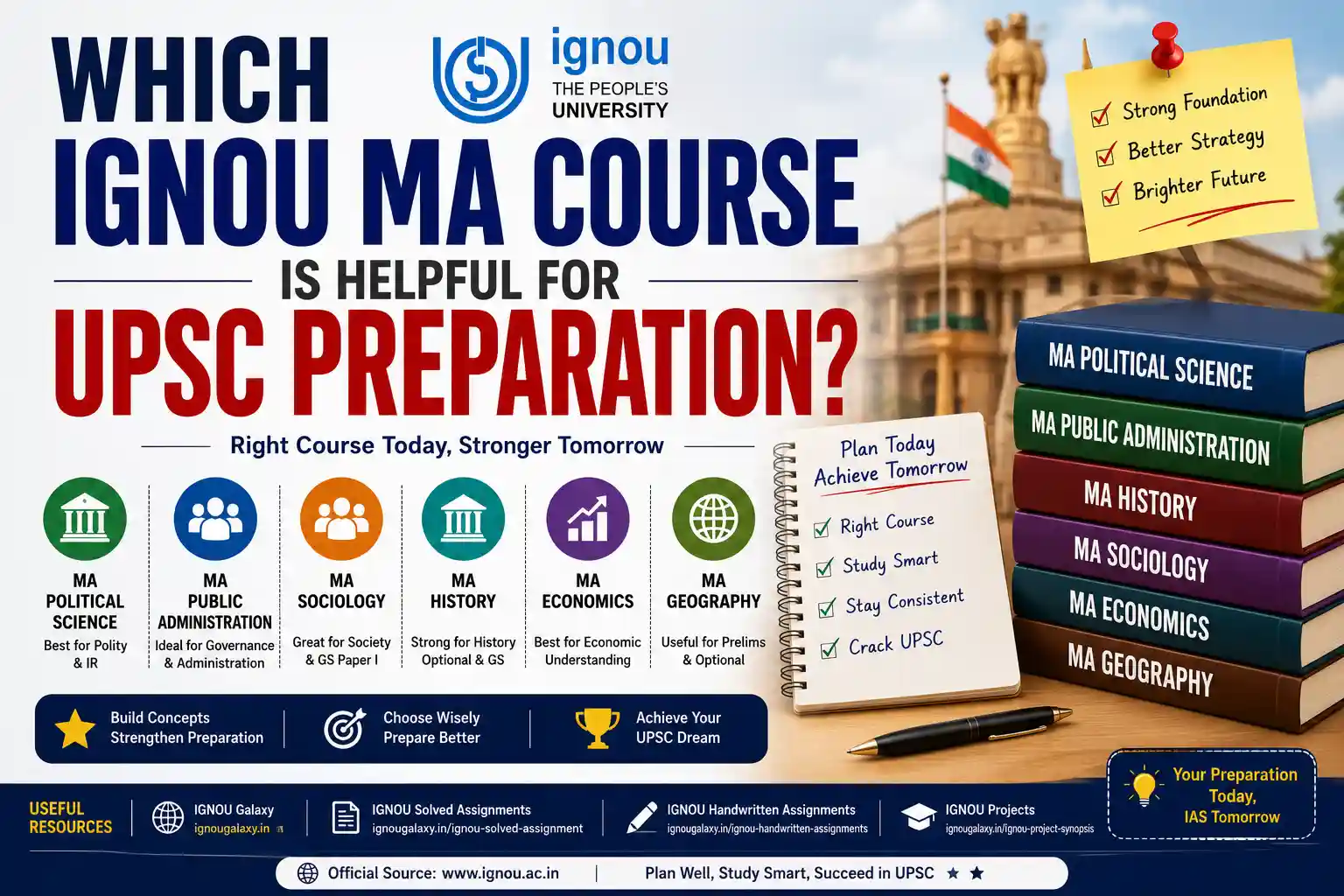
UPSC aspirants often ask our team which IGNOU MA is most useful if they’re going to do one anyway. Our answer is a decision rule, not a ranking: choose the MA that matches your optional. An MA in your optional subject can double as structured preparation. An MA in an unrelated subject becomes a second syllabus competing for your time.
| If your optional is… | The matching IGNOU MA |
|---|---|
| Political Science and International Relations (PSIR) | MA Political Science (MAPS) |
| Public Administration | MA Public Administration (MPA) |
| Sociology | MA Sociology (MASO) |
| History | MA History (MAHI) |
If you haven’t chosen an optional yet, the MA Political Science is one reasonable choice, because its political theory and Indian polity courses also overlap with General Studies Paper II. But it’s worth deciding your optional first; the MA should follow that decision, not make it for you.
How the MA Political Science maps to PSIR
Here’s a course-level comparison between the current MAPS course list and the four sections of the PSIR optional. It’s based on course titles, so use it as a starting point and check the block contents on eGyanKosh against the official syllabus in the UPSC Civil Services notification.
| PSIR section | MAPS courses that cover it | What you’ll still need |
|---|---|---|
| Paper I A: Political theory and thought | MPS-101 and MPS-106 (Political Theory), MPS-105 (Western Political Thought) | Indian political thinkers; the elective MPSE-004 (Social and Political Thought in Modern India) helps |
| Paper I B: Indian government and politics | MPS-102 and MPS-107 (Indian Political System) | Recent developments and current issues |
| Paper II A: Comparative politics and international politics | MPS-104 and MPS-109 (Comparative Politics), MPS-103 and MPS-108 (International Relations) | Current international events and institutions |
| Paper II B: India and the world | Partly MPS-108 | India’s foreign policy in depth, from dedicated sources and current affairs |
A note on course codes
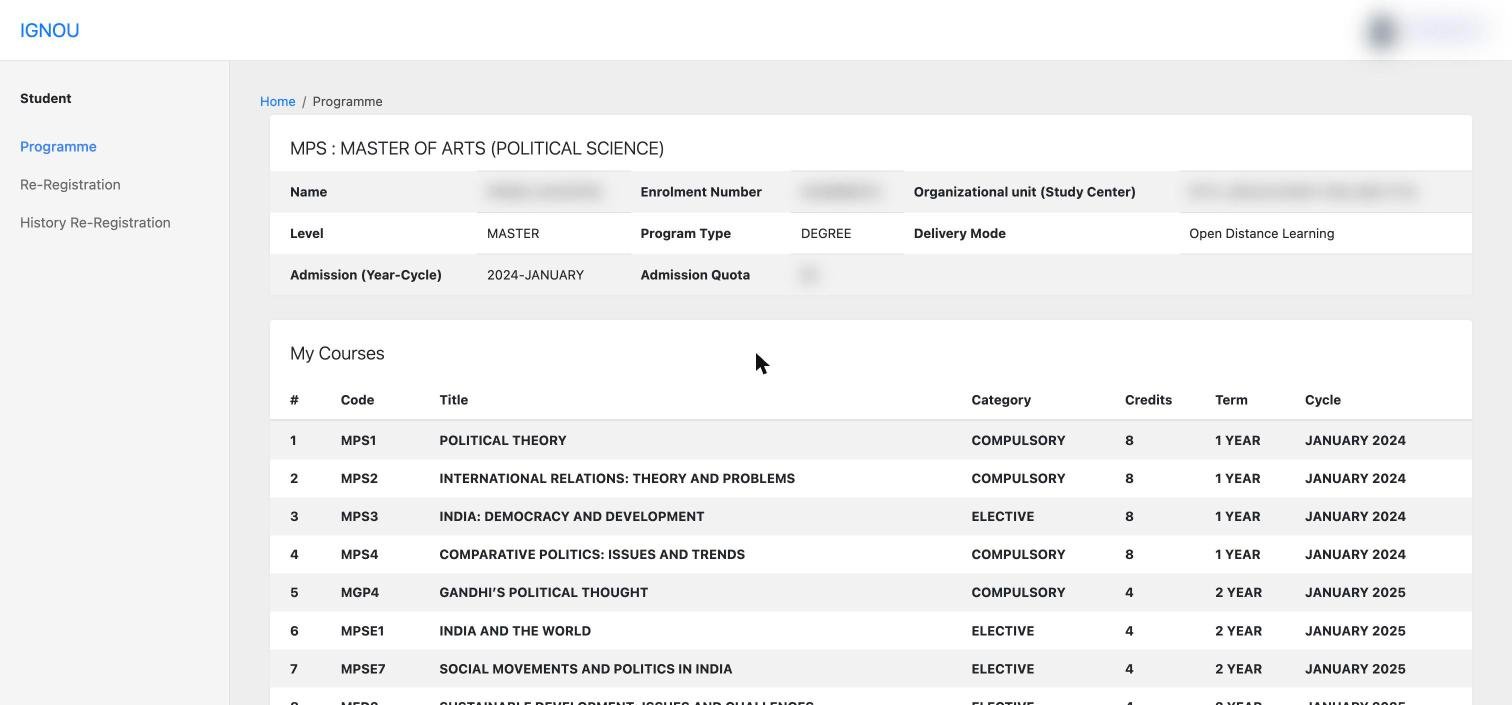
Students admitted in earlier sessions may have an older version of the programme with different codes. The screenshot below is from a student admitted in January 2024, whose first-year courses carry MPS1 to MPS4 codes.
Thinking through the other options
Public Administration optional: the MPA lines up with administrative theory and Indian administration, and it also suits people already working in government.
Sociology or History optional: MASO and MAHI are useful for those optionals and fairly reading-heavy. For History, our guide on using the MA History blocks describes a method that also works for UPSC.
Economics without it being your optional: think carefully. Quantitative Methods takes real time, as our MA Economics guide explains.
From our support desk
One student our team supported, from Uttarakhand and enrolled in IGNOU’s MA Public Administration, used the IGNOU blocks as his main reading for the Public Administration optional and reached the UPSC interview stage. We’ve kept him anonymous. His is one student’s experience: it shows the material can work as core reading; it doesn’t show the programme will work the same way for everyone.
Making it work alongside preparation
The main risk is running two syllabuses at once. Students who manage it well read each block once for the MA and mark the parts that match their optional, so they revise them once. They treat assignments as answer-writing practice with a real deadline. And they check the calendar early: IGNOU’s term-end exams are held in June and December, and shouldn’t clash with Prelims or Mains in their attempt year. The MA won’t replace current affairs or General Studies preparation.
For whether an IGNOU degree meets UPSC’s graduation requirement and how recognition works, see our guide on whether an IGNOU degree is valid.