 © Copyright 2026 IGNOU Galaxy.

Home › Guides › Study material
IGNOU Study Material: Printed Books, eGyanKosh, and How to Study From the Blocks
SSBy Shreyansh Shylendran, Founder and CEO, IGNOU Galaxy
Updated 13 November 2026 · 10 min read
IGNOU is a distance university, so its study material does the job a lecturer does elsewhere. Every course comes with self-learning material written to be studied alone: blocks, divided into units, each unit built to take you from the basics to exam-level understanding. How well you use that material decides most of how your term-end exam goes.
This guide explains what you actually receive, whether to take printed books or the digital version, how many hours a course really asks of you, how students who do well use the blocks, what to do if the material is out of date or simply hasn't arrived, and how the same books help people preparing for competitive exams. It uses IGNOU's July 2026 prospectus, the material on eGyanKosh, and what our team sees every session.
IGNOU Galaxy is an independent academic-support service, not part of IGNOU. Everything official here links to IGNOU's own websites.
What study material does IGNOU give you?
IGNOU calls it self-learning material (SLM). Section 1.11 of the July 2026 prospectus says printed material is supplied for the theory and practical parts of programmes, as a single print book, an e-book, or separate printed blocks for each course, "on an average 1 block per credit". A 4-credit course, then, usually comes as about four blocks.
Each block is divided into units, and each unit follows a fixed shape. Here is the opening page of a real unit, Unit 2 of MCO-021 Managerial Economics, as it appears on eGyanKosh:
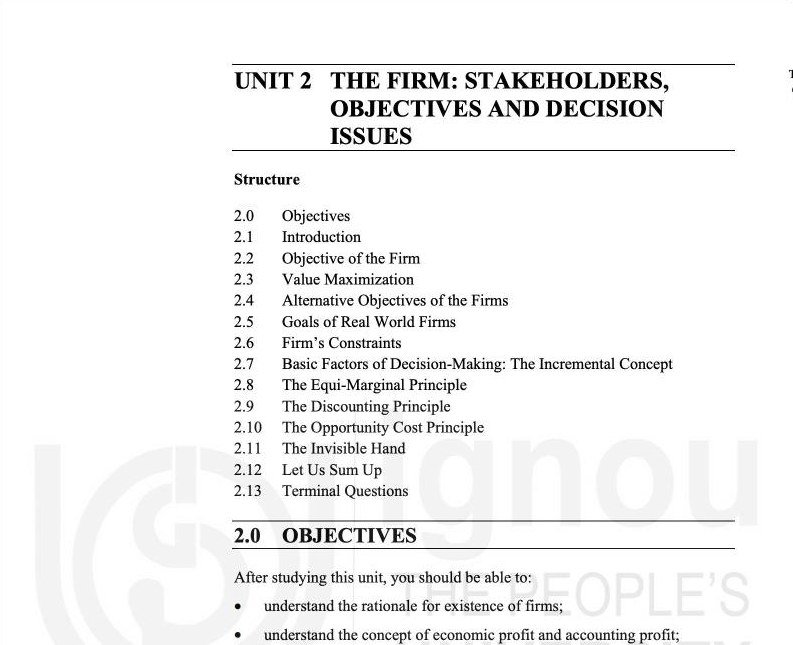
Three parts of that structure matter most when you study:
- Objectives tell you what you should be able to do at the end of the unit. If you can't do them, you haven't finished the unit.
- Let Us Sum Up is the unit in a page. Read it first to see where the unit is going, and again at the end to check you have the main points.
- Terminal Questions are the closest thing in the unit to an exam question. Attempt them in writing, along with any self-check questions your course includes.
Alongside the blocks, you will need your programme guide (for rules and the course list) and the assignments for your session, which are published separately each session. Neither is part of the course blocks.
How many hours does an IGNOU course really take?
More than most students expect. Section 1.9 of the prospectus says "each credit in our system is equivalent to 30 hours of learner study". That turns into real numbers quickly:
| Course size | Study hours (prospectus) | Per week, over 20 weeks | Per week, over 40 weeks |
|---|---|---|---|
| 2 credits | 60 hours | About 3 hours | About 1.5 hours |
| 4 credits | 120 hours | About 6 hours | About 3 hours |
| 6 credits | 180 hours | About 9 hours | About 4.5 hours |
| A typical year of 32 credits | 960 hours | About 48 hours | About 24 hours |
The weekly figures are simple division, not an IGNOU rule. They show why the students who do well start early: three hours a week for a 4-credit course is manageable across a year, but cramming 120 hours into the last month isn't.
Printed books or digital: which should you choose?
IGNOU gives you the choice at admission. Section 14.13 of the prospectus says a learner can take a soft copy of the self-learning material instead of printed books, and that "a learner opting for the soft copy will be given a discount of 15% in the Programme Fee." The option has to be chosen on the online admission form, and learners who choose it "will not be given printed self-learning material". The digital material is on eGyanKosh, IGNOU's digital repository.
| Printed books | Digital (soft copy) | |
|---|---|---|
| Cost | Included in the programme fee | 15% discount on the programme fee |
| How you get it | Posted to you, or issued from your Regional Centre | Free on eGyanKosh and the IGNOU e-Content app |
| Access to eGyanKosh | Yes, eGyanKosh is open to everyone | Yes |
| Wait for delivery | Yes; see our book status guide | No |
| Reading comfort | Easier for long study sessions | Screen reading for long blocks |
Our team's experience is that most students prefer printed books. IGNOU's material is long and bulky, and reading it from a screen for hours strains the eyes. Students who take printed books can still use eGyanKosh whenever they like, but students who opt out of printed material can't ask for printed books again for that semester. If you aren't sure, the printed option keeps both doors open.
The digital route suits students who are comfortable reading on a laptop or tablet, who want the fee saving, or who need the material straight away. Our eGyanKosh guide shows how to find your exact course there.
How do the books reach you?
IGNOU sends the printed material course by course. You can check the dispatch status of each course on IGNOU's Know Your Status page, which lists a separate status tool for each admission session. The record we looked at, for an MCOM learner in the January 2025 session, showed some courses sent from the Regional Centre's stock and others sent with a headquarters label and an India Post bar code, each with an expected date of delivery.
Our book status guide walks through the status page line by line and explains what to do if a parcel doesn't come.
How should you study from IGNOU blocks?
In our team's experience, the students who get the most from IGNOU books make a schedule for the whole year and work through it steadily. They use the blocks to understand each concept properly first, and only later turn to sample papers for practice. The students who struggle often try to read everything at the end, and retain very little of it.
A method that works, unit by unit:
- Read the objectives and "Let Us Sum Up" first, so you know what the unit is for.
- Read the unit once, slowly, without notes. Mark the definitions, diagrams and lists.
- Make one page of notes per unit in your own words: the definitions, the key arguments, and any diagram or formula.
- Answer the terminal questions in writing, without looking, then check against the unit.
- Map the unit to the exam. Look up the course's previous-year papers and note which questions came from this unit. Our term-end exam guide explains where to find past papers and how to plan the three hours.
- Use the unit for your assignment, in your own words. Our team's advice is to understand the concept from the official material first, and only then look at model answers, writing the final answer yourself. Our assignments guide covers this in detail.
A practical rhythm: one unit per sitting, notes the same day, and one revision pass over the notes every few weeks. By the exam, you are revising one-page notes, not re-reading 400 pages.
Are some IGNOU books outdated?
Some students tell us they are. In our team's experience, students have found parts of the older BAG material dated, with newer versions not yet released, and BCA and MCA students have pointed out that some newer areas of technology, such as AI and machine learning, are thinner in IGNOU's material than in some private universities' material. Our team also points out that IGNOU regularly updates its material, and newer programmes such as BCA_NEW and MCA_NEW have their own revised syllabi.
What to do about it:
- Make sure you have the right version. On eGyanKosh, the same course code can sit under more than one programme. Use the copy under your programme and the "Current" level. Our eGyanKosh guide shows how.
- Check the year on each unit. eGyanKosh shows an issue date for every unit.
- Treat the block as the syllabus, not the ceiling. Where a topic has moved on, a recent textbook, a reliable government source or a good online course can bring you up to date. Answer exam questions on the basis of the block, and add newer points only where they fit.
Books haven't arrived and exams are close: what now?
Don't wait. Work through these in order:
- Start on eGyanKosh today. The full course material is there free, unit by unit, for every student. You don't need the printed copy to begin. See our eGyanKosh guide.
- Check the dispatch status for your session, so you know whether the course was sent, from where, and when it is expected. Our book status guide explains each column.
- Contact the right office. The prospectus says that for non-receipt of study material, learners should write to the Registrar, Material Production and Distribution Division (MPDD), IGNOU, Maidan Garhi, New Delhi 110068, and it lists mpdd@ignou.ac.in and 011-29572008 or 29572012. Your Regional Centre can also tell you whether it has stock.
- Use a printed guide if you need one. Our team sees delays most often when particular books are out of stock. When that happens close to the exam, we suggest students prepare from private publishers' study material for that course. You can also look at our own IGNOU guess papers, which we publish for exam practice; please note they are IGNOU Galaxy's product, not IGNOU's.
One of our students, Tanya, was in exactly this position. Her study material still hadn't arrived as the exam deadline came close, so she bought private study material for the course and prepared from that.
One caution: the prospectus also says that if a student doesn't receive the material "for any reason; whatsoever, the University shall not be held responsible". The exam date won't move because a parcel is late, so start with eGyanKosh rather than waiting.
Can you buy IGNOU books without taking admission?
Yes. IGNOU's Material Production and Distribution Division sells study material to the public. Its price catalogue says the material is meant for "general public, who are not IGNOU's students, in-service personnel interested in good reading, students needing to know more about the subject by minimum reference and job aspirants appearing in various competitive exams".
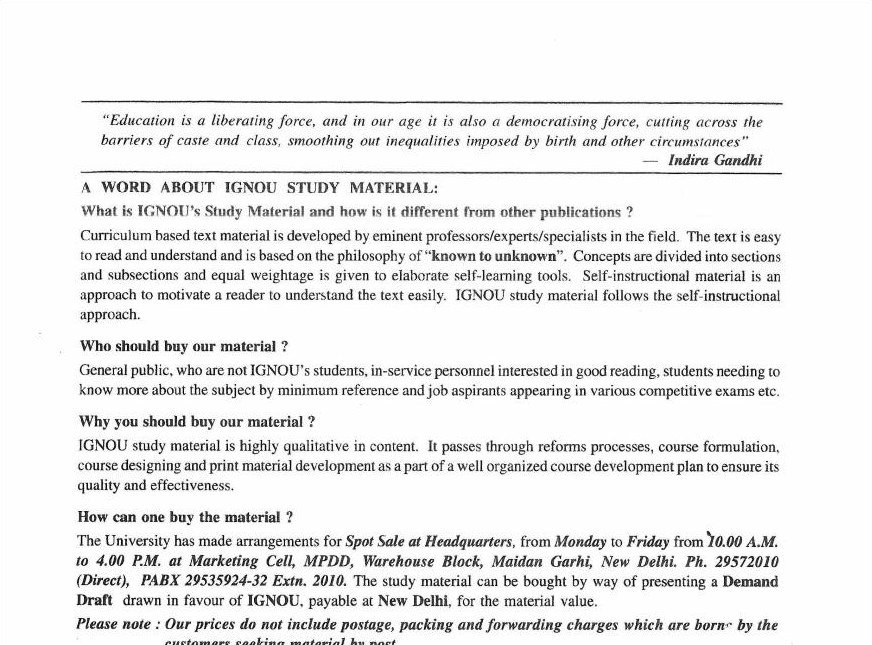
The catalogue describes spot sale at the MPDD Marketing Cell at Maidan Garhi, New Delhi, on weekdays, against a demand draft in favour of IGNOU, with postage extra if you want the books sent. The catalogue on the website is dated August 2017, so check prices and the current process with MPDD before you send anything. For most people, the free eGyanKosh copy is the simplest route, and IGNOU's e-Content app puts the same material on a phone.
Are IGNOU books useful beyond your degree?
Very much, and IGNOU itself says so: its price catalogue names "job aspirants appearing in various competitive exams" among the people the books are for. Our team has seen many UPSC aspirants use IGNOU material in much the way they use NCERT books, to build a clear base before moving to advanced sources.
One of our own students shows how far that can go. Avneesh Mishra, from Uttarakhand, was enrolled in IGNOU's MA in Public Administration. He used the course material thoroughly, cleared both the UPSC preliminary and main examinations, and reached the interview stage.
If you are preparing for UPSC or UGC NET, our posts on which IGNOU MA helps most with UPSC and whether IGNOU MA History books are enough for NET map specific IGNOU courses to those syllabi.
Questions students ask us about study material
If I opt for printed books, can I still use eGyanKosh?
Yes. eGyanKosh is open to everyone, and our team's experience is that students who take printed books can still use it, for example while waiting for a parcel.
I opted for the soft copy. Can I get printed books later?
The prospectus says learners who take the soft copy "will not be given printed self-learning material", and in our team's experience students can't switch back to printed books for that semester. You can still buy books from MPDD.
Are the Hindi-medium books the same as the English ones?
They cover the same course, written in Hindi, and eGyanKosh lists Hindi versions separately. For MCO-021, for example, searching the course code shows the Hindi course, एम.सी.ओ.-021 प्रबंधकीय अर्थशास्त्र, alongside the English ones.
Is IGNOU study material free to share?
No. eGyanKosh says its items "are protected by copyright, with all rights reserved by IGNOU, unless otherwise indicated." Read and download it for your own study, but don't republish it.
Sources checked 13 November 2026
- IGNOU Common Prospectus, July 2026 (sections 1.9, 1.11, 1.20, 1.21, 14.13 and 18)
- eGyanKosh and the MCO-021 Managerial Economics material, viewed 13 November 2026
- IGNOU Know Your Status: study material status, viewed 13 November 2026
- IGNOU price catalogue of study material (dated August 2017)
- IGNOU e-Content app