 © Copyright 2026 IGNOU Galaxy.
Is the IGNOU BSc Exam Semester-Based? Complete Guide
The existing IGNOU Bachelor of Science Multidisciplinary programme is based on a semester pattern of study. Students study and register for courses semester wise. But, the main Term-End Examinations of IGNOU are held twice a year, in June and December.
This confuses new students a lot. The course schedule is decided by the IGNOU BSc Semester System and the June and December TEE schedules decide the time when the eligible students will appear for the examinations.
The exact rules may differ for students registered under older BSc formats like BSC, BSCG or other closed admission formats. All students should therefore check the programme code and relevant programme guide before arranging examinations.
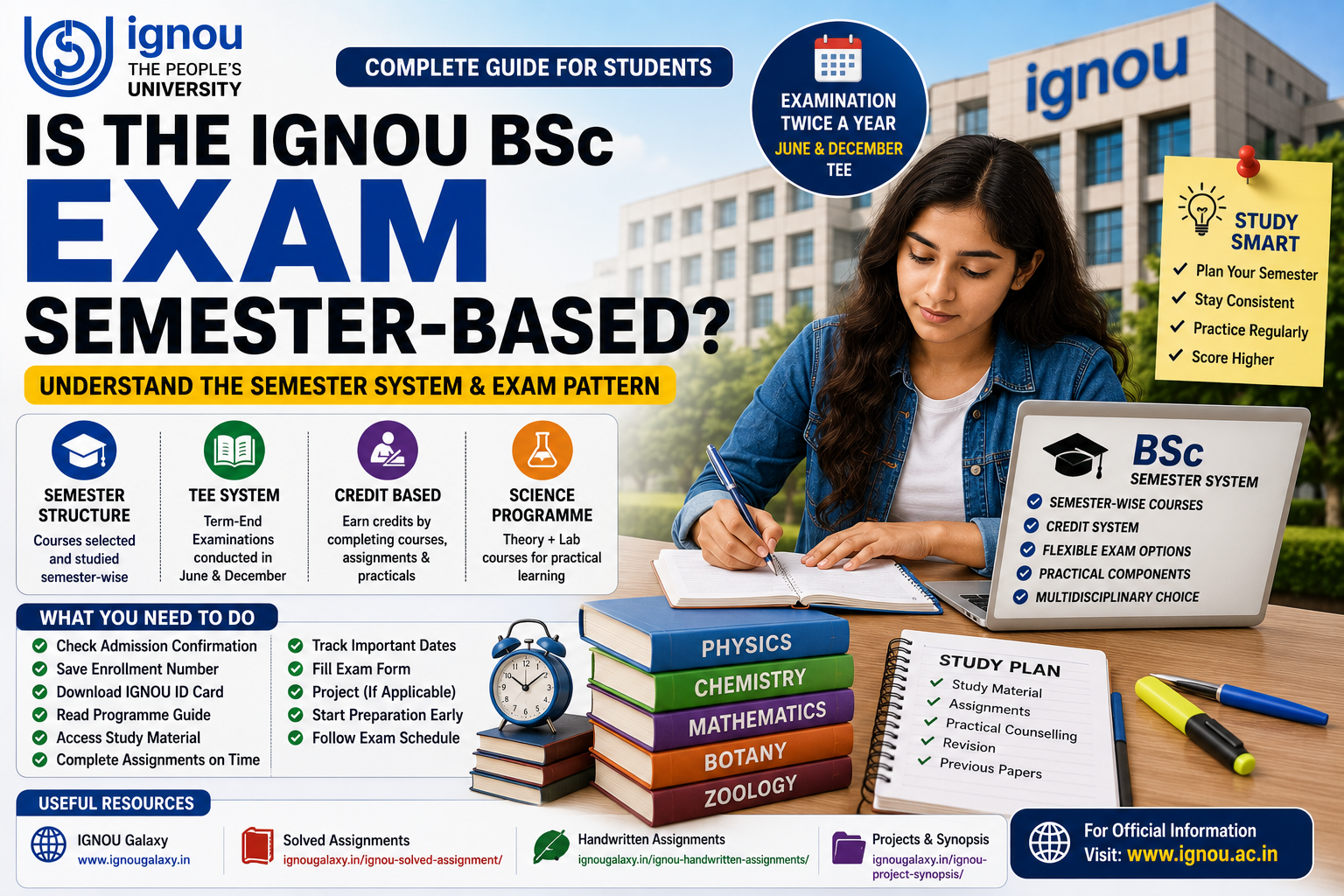
IGNOU BSc Semester System Procedure
The present IGNOU BSc programme is available under programme code BSCM. It offers its courses semester-wise under a multi-disciplinary undergraduate structure.
Students are enrolled in a fixed set of courses in each semester. Depending on the structure of the programme, these include:
- Courses in the major or discipline
- Other minor/support discipline courses
- Courses that transcend disciplines
- Ability development courses
- Skill improvement courses
- Courses with added value
- Laboratory classes
- Internship, vocational or research elements where appropriate
According to the official page of the BSCM programme, it is a multidisciplinary science programme developed under the current undergraduate framework. ([IGNOU][1])
Semester System and TEE Sessions Don't Match
The term ‘IGNOU BSc Exam Semester Based’ does not mean that a separate university wide examination has to be held immediately after every six months study period.
IGNOU generally conducts its Term-End Examination twice a year:
- End Term Examination June
- Term-End Examination, December
The university’s official academic calendar and examination guidance lists June and December as the two main TEE sessions. ([IGNOU][2])
A student admitted in July session will normally prepare for courses based on the schedule of the relevant semester and the minimum study period. A January session student is equivalent to the January entry cycle.
IGNOU BSc Course Pattern
The IGNOU BSc Course Structure is formulated as per the programme and admission year. Current BSCM students study science as a multi-disciplinary mix.
Science disciplines available may be:
- Type of body
- Chemical Engineering
- Mathematics
- Plant Biology
- Zoological
- Geology
- Geographical
Students must follow the rules regarding permitted subject combinations. They are unable to freely choose unrelated course codes without regard to discipline groups, prerequisites and laboratory requirements.
The exact semester-wise distribution of courses can be confirmed from the BSCM programme guide. ([IGNOU][3]
Understanding the Credit System of IGNOU BSc
IGNOU has a credit based system of education. Credits are a measure of the amount of learning effort required to complete a course.
The credit workload may comprise:
- Reading of study materials
- Academic advising;
- Preparing for the assignment
- Teach yourself
- Lab work
- Prep for tests
- * Project or fieldwork
The degree is awarded only after the student has satisfied the credit requirement and passed all required components.
“Just because you sit in the examination doesn’t mean you’ve done the course. There may also be other requirements for assignments, practicals and other compulsory components.
Verify Your Admission Confirmation
And after applying for admission check whether your application is approved by IGNOU or not.
Verify:
- Code du programme
- Session d’admission
- Chosen disciplines
- Regional Centre
- Learners support centre
- Recorded course codes
Keep your confirmation of admission and receipt of payment. Students admitted under BSCM are not to be expected to follow the course structure of BSCG or any previous BSc programme.
Retain Your Enrolment Number
Your enrolment number is required for most academic activities.
Keep safely for:
- Re-registering
- Uploading assignment
- Forms for examination
- Hall tickets
- Practical timetables
- * Findings of the study
- Checking Marksheets
Save it on your phone, in your email, and in a printed student file.
How to Download IGNOU ID Card
Upon admission confirmation, download the student ID card.
Check whether it has the right:
- Name •
- Picture
- - Number of enrolments
- Programme code
- Entry session
Carry the ID card during laboratory counselling, practical examination and IGNOU BSc TEE
Go Through The Programme Guide Thoroughly
The program guide is very important as it will tell you how the semester system works for your batch.
It usually includes:
- Courses semester-wise
- Credit requirements
- Rules for subject combinations
- Assignments
- Real-world classes
- How it is assessed
- Renewal of Registration
- Length of the programme
- Exit and degree completion requirements
Do not depend on old videos or course lists as the IGNOU Science Programme has been restructured.
Get the Correct Study Material
Get or Download Study Material based on your registered Course Codes. Organise it by topic and by semester.
Create individual folders for:
- Theory subjects
- Laboratory handbooks
- Hausaufgaben
- Old question papers
- Workable schedules
- Exam papers
For general student guidance, one can refer to IGNOU Galaxy. However, for confirmation of syllabus, the official IGNOU programme guide and registered course details should be referred to.
Submit Assignments on Time
The assignments are part of the continuous assessment process of the relevant theory courses. Students must download the assignment booklet relevant to their programme, course code and validity period.
IGNOU Solved Assignments will help Students to learn how to present answers. IGNOU Handwritten Assignments will help students in writing. These should be used as a reference rather than direct copying.
For science projects:
- Write formulas legibly.
- Show the calculation steps.
- Use proper units.
- Draw labelled diagram.
- Report findings in plain language.
- Adhere to the specified word limit.
Practical attendance at counselling
There are many IGNOU BSc Subjects that include compulsory lab courses. Designated Learner Support Centres can organise practical counselling and laboratory examinations.
Students will be able to:
- Participate in the scheduled laboratory sessions.
- Fill in the practical record.
- Find out how to use instruments.
- Make calculations and observations.
- Revise safety measures and viva questions.
- Check regularly the notices of the Regional Centre.
The theory exam date sheet may be different from the practical schedule.
Filling IGNOU Examination Form
A student is not automatically registered for the Term-End Examination on the basis of admission or submission of assignments by IGNOU.
Here is what you do:
- Verify your registered course codes.
- Verify that the minimum period of study has been completed.
- Choose the correct TEE session for June or December.
- Select your preferred examination centre.
- Pay the examination fee as prescribed.
- Save the acknowledgement.
- Status of the application.
- Download the Hall Ticket on release.
Currently, IGNOU has a separate online examination form facility for each TEE cycle. ([IGNOU Exam Form][4])
Can Students Appear for Multiple Semesters Together?
IGNOU usually provides flexibility to appear for eligible registered courses in a June or December TEE. Hence a student with incomplete papers from a previous semester may sometimes sit for them along with eligible current semester courses.
This will depend on:
- Registration for a valid course
- Minimum level of education attained
- Programme validity
- Completion of examination form
- Practical and assignment needs
Students shall not register for papers for the next semester until they become academically eligible.
Date Sheet of IGNOU BSc Exam
The IGNOU BSc Exam Schedule is issued as a common date sheet with course codes from various programmes.
To verify your dates:
- List all the registered course codes.
- Download the official calendar sheet.
- Research each code individually.
- Record the date and session.
- Search for updated versions.
- Compare your hall ticket with the schedule.
Theory exams are generally conducted in the morning and evening sessions. Practical examinations may be held according to a separate Regional Centre timetable.
Submit a Synopsis or Project
Not every BSc student will have a standard project or synopsis. This requirement depends on the programme structure and the courses selected.
Students can refer to IGNOU Projects for general guidance regarding selection of topic and formatting of dissertation, internship or research component, where applicable. The official manual should be followed and the final work should be original.
Don’t Wait to Start Studying
Good time-table for IGNOU BSc study is:
- Study 1 theory unit each day.
- Practice numerical questions on a regular basis.
- Change diagrams and definitions.
- Set aside one day for lab records.
- Turn in assignments on time.
- Practice previous year question papers.
- Keep a formula book.
- Review all registered courses no less than twice.
The semester wise system is good if students study continuously and not wait till TEE date sheet.
Errors to Steer Clear Of
- Mistaking semester registration for examination periods.
- Assuming that exams are held once a year
- Reading from an old BSc syllabus
- Selecting course codes not registered
- Not observing the lab requirements
- Re-registered unregistered
- TEE registration will be automatic upon submission of your assignment
- Old date sheet after
- Appearing before the minimum study period is over
- Merging BSCM and BSCG course structures
Questions that are often asked
1. Is the IGNOU BSc on a semester system now?
Yes. The current BSCM programme is a semester based course structure.
2. How often TEE is conducted by IGNOU?
IGNOU conducts the Term-End Examination generally twice a year in the month of June and December.
3. Is there a different date sheet for each semester’s exams?
Usually IGNOU releases a common date sheet for TEE with course codes of multiple programs and semesters.
4. Can I give first semester and second semester exams together?
If you have completed the required study period and other conditions you may appear for all eligible registered courses.
5. Do practical exams are conducted in semester?
The practical courses follow the programme structure but their examination dates are usually announced separately by the Regional Centres.
6. Do students have to do assignments?
Assignments are mandatory for the concerned courses and form the part of evaluation process.
7. Is the examination form compulsory for all the TEEs?
Yes. Students have to fill the examination form separately for each June or December session.
8. What happens if I fail a semester paper?
You can typically re-sit a TEE at a later date, as long as your course registration is current.
9. Are BSCG and BSCM same?
No. They are different programme structures and they may have different courses codes and requirements.
10. How can I get to know my exact exam dates?
Check latest official IGNOU date sheet. Search for every registered course code.
Last Tips for New IGNOU Students
Step 1: Know your programme code and admission cycle Then list the theory, practical and supporting courses semester wise.
Do not consider the June and December examinations as separate programme structures. Think of them as TEE opportunities. Keeping up with re-registration, assignments, lab work and exam forms will prevent most academic delays.
Conclusion
So the answer of “Is IGNOU BSc Exam Semester Based?” is Yes, especially for the ongoing BSCM programme. Courses and credits are semester-wise and the main Term-End Examinations are held twice a year in June and December.
Students must follow their registered programme structure, complete assignments and practical work and submit the examination form for eligible courses. Knowing the difference between semesters & TEE sessions makes the planning of the IGNOU BSc Distance Education journey lot easier.