Is a BCA From IGNOU Worth It? Fees, Labs and Where Graduates Actually Work
AKBy Afjal Khan, COO, IGNOU Galaxy Updated 11 November 2026 · 4 min read
“Will my IGNOU BCA have any value?” Our team hears this from students just out of Class 12 and from working people in their thirties. Our answer is the same for both: it can, if you use the three years well. IGNOU’s BCA is a recognised degree at a modest cost, but the degree alone won’t make you job-ready as a developer. What you build alongside it matters a great deal.
It’s a good fit if…
Think twice if…
You’re working and need a recognised degree to move up
You want regular campus life and on-campus recruitment drives
You can learn coding on your own, beyond the syllabus
You expect the course material alone to make you job-ready
You want a low programme fee: ₹49,800
You can’t get to lab sessions at a study centre
You plan to continue to an MCA
You want the newest AI and ML topics built into the syllabus
What it costs. The BCA_NEW programme page lists a programme fee of ₹8,300 per semester, ₹49,800 for six semesters. On top of that you pay a registration fee at admission and term-end exam fees (₹200 per theory course in the July 2026 prospectus), so the total is more than ₹49,800. Eligibility is 10+2 or equivalent, and the programme takes three to six years. These figures are from the pages as checked on 11 November 2026 and apply to the current BCA_NEW programme; the BCA programme guide has the full curriculum and practical rules.
Placement support. IGNOU has a placement assistance service (linked from ignou.ac.in under Student Services), but a distance programme doesn’t work like campus recruitment at a regular college. Plan to find opportunities yourself.
YEAR 1
Labs from the very first semester
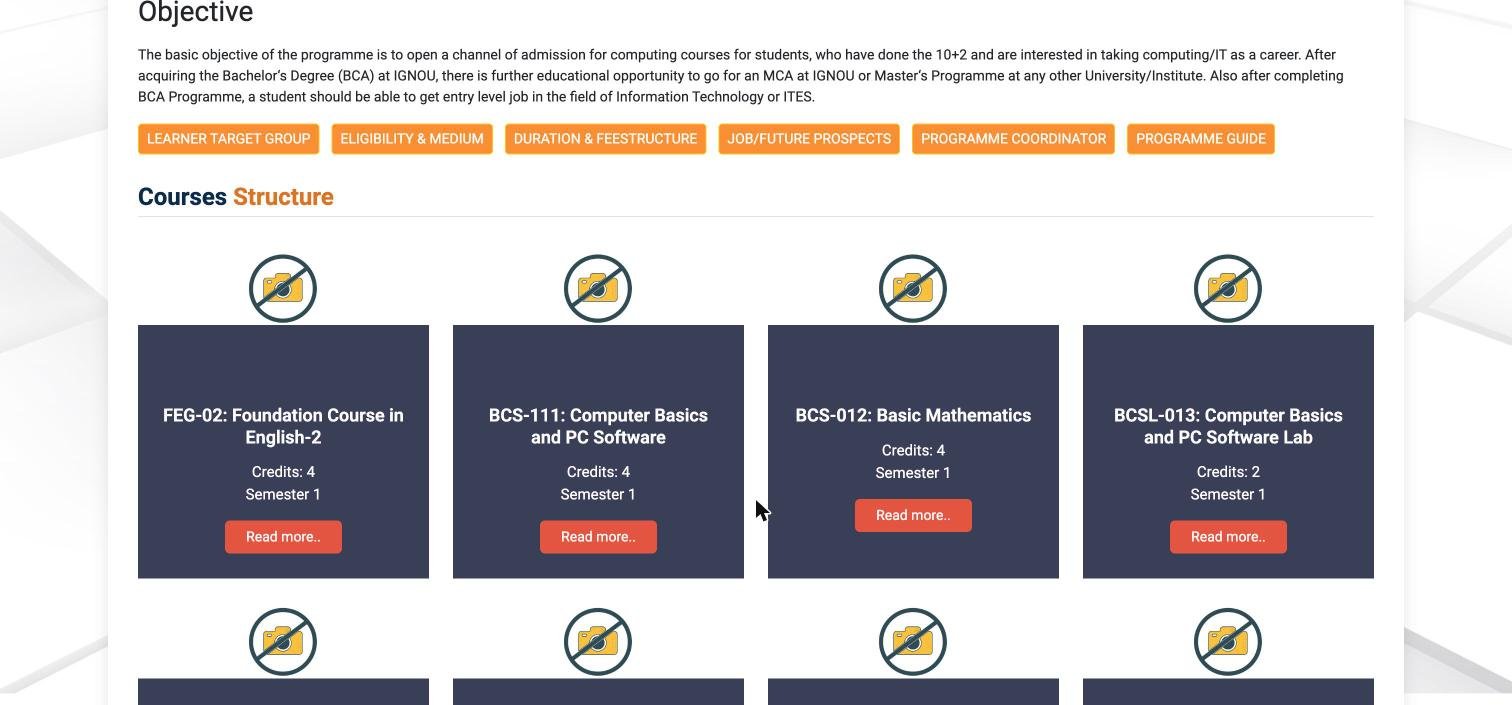
A distance BCA isn’t only reading and assignments. BCSL-013, the Computer Basics and PC Software Lab, runs alongside the first-semester theory courses, and more labs follow later. Labs are held at your study centre, so before you enrol, find out which centre you’d be attached to, how far it is, and when it runs labs. Students our team has assisted have lost a whole session because lab timings clashed with work.
First-semester courses on IGNOU’s BCA_NEW programme page, including the BCSL-013 lab (captured 11 November 2026).
Year one is also when habits form. Writing small programs regularly, even simple ones, makes a large difference by year three.
YEAR 2
Pick a language and go deep
By the middle of the programme you’ll meet object-oriented programming in Java (MCS-206), along with operating systems and networking. This is a good time to commit to one language and build two or three small projects in it, published on GitHub, rather than skimming several.
A limitation students mention
Several of our BCA and MCA students have told us that parts of the material feel behind on newer areas like AI and machine learning. That’s their perception, not a formal comparison. If you want to work in those areas, plan to learn them alongside the degree.
YEAR 3
A project that shows what you can do
The final semester includes BCSP-165, a 12-credit project. Follow the requirements in the programme guide and the project guidelines issued for your session. Beyond meeting them, build it so it can also go in your portfolio. A project that’s useful to an employer usually has:
a working demonstration you can show in five minutes;
clear documentation: what it does, how to install and run it;
evidence of testing: what you checked and what failed;
an honest account of your own contribution if others helped.
A strong project helps in interviews; it doesn’t by itself secure a job.
After the BCA
Many students choose the BCA to support an appraisal or promotion where they already work. Others want a low-cost route into IT. A few students known to our team completed a BCA and then an MCA at IGNOU and now work at software companies in Noida and Bengaluru. Those are individual examples, not placement statistics. If you plan to continue to the MCA, decide early and choose electives with that in mind.
If an interviewer asks why you chose distance learning, a straightforward reason such as “I was working at the same time” is usually enough. For how employers and universities treat IGNOU degrees generally, see our guide on whether an IGNOU degree is valid and recognised.
 © Copyright 2026 IGNOU Galaxy.