 © Copyright 2026 IGNOU Galaxy.

Home › Guides › Is an IGNOU degree valid?
Is an IGNOU Degree Valid? Recognition, Jobs and Higher Study, Explained
SSBy Shreyansh Shylendran, Founder and CEO, IGNOU Galaxy
Updated 11 November 2026 · 6 min read
Updated 11 November 2026 · 6 min read
I did my B.Sc from IGNOU, finished it in the minimum three years with a first division, and my first job afterwards was with a multinational company. That’s my own experience, and one person’s career proves very little on its own. So instead of asking you to take my word for it, this guide sets out what the official documents say about IGNOU’s recognition, where to read them yourself, and the limits of what “recognised” means for any particular job.
The short answer
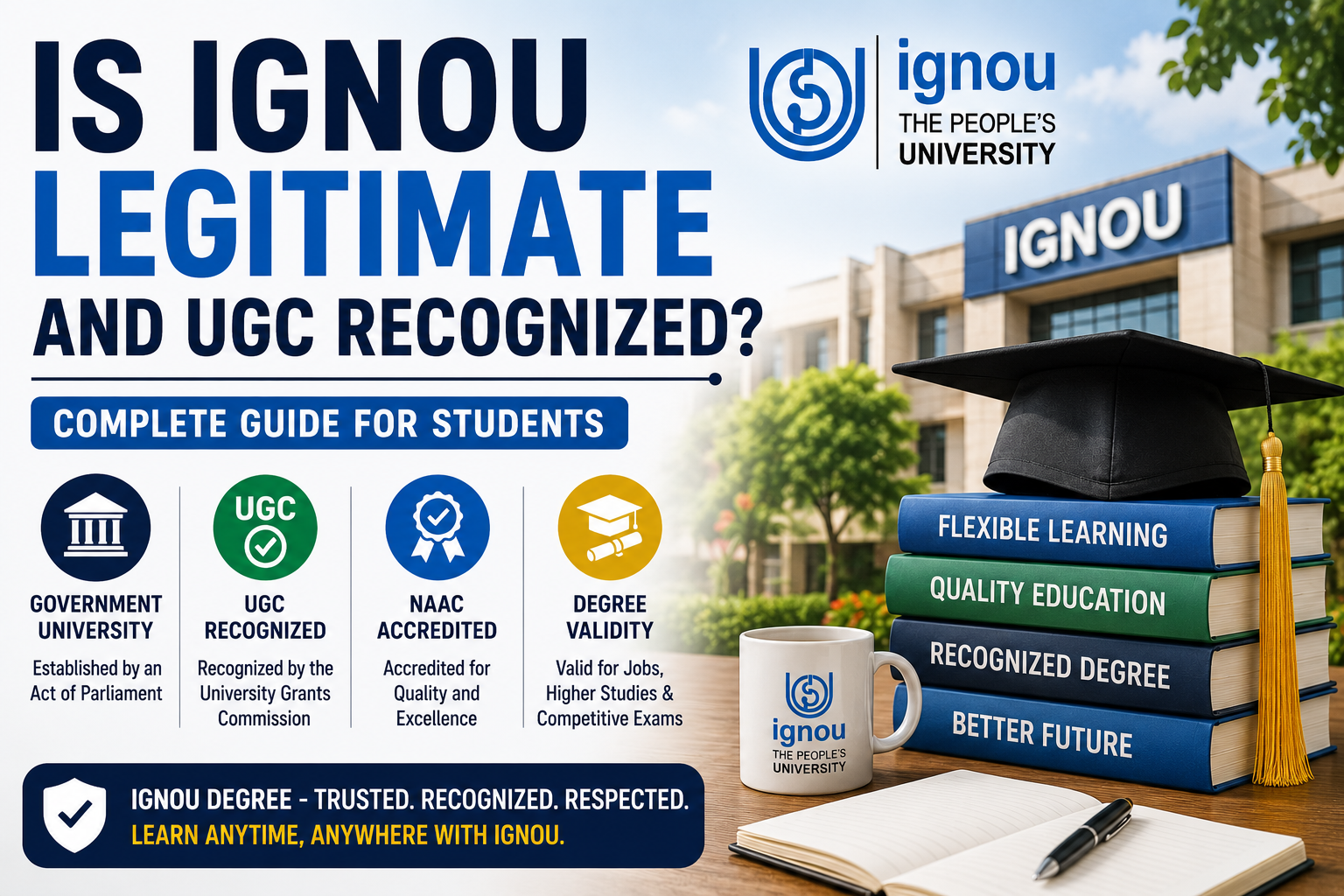
IGNOU is a central university established by an Act of Parliament in 1985. Its Common Prospectus states that its degrees are recognised by all member institutions of the Association of Indian Universities and are at par with corresponding degrees of other Indian universities. UGC regulations treat degrees earned through open and distance learning as equivalent to those earned in conventional mode. Equivalence isn’t an automatic yes for every vacancy, though: each job or admission can still set its own conditions.
What the official documents say
| Point | What the document says | Where to read it |
|---|---|---|
| Legal status | IGNOU was established by an Act of Parliament in 1985 (Act No. 50 of 1985) | IGNOU Common Prospectus, July 2026 |
| Recognition of degrees | Degrees, diplomas and certificates are recognised by all member institutions of the Association of Indian Universities, and are at par with corresponding awards of Indian universities | Common Prospectus |
| UGC distance-education rules | IGNOU is exempted from the applicability of the UGC (Open and Distance Learning Programmes and Online Programmes) Regulations, by UGC letter F. No. 1-8/2019 (DEB-I) dated 9 August 2019, and its programmes are at par with programmes approved by the UGC Distance Education Bureau | Common Prospectus |
| Equivalence with regular degrees | UGC’s regulations provide that degrees earned through open and distance learning are treated as equivalent to corresponding degrees in conventional mode | UGC regulations compendium (Regulation 22) |
One point surprises people: because of that exemption, IGNOU is not treated like other universities that need UGC Distance Education Bureau approval programme by programme. So if you look for IGNOU on the Bureau’s recognised-institutions list and don’t find it, that isn’t a warning sign. The exemption letter cited in IGNOU’s prospectus is the relevant document. Some professional programmes need a separate regulator as well; the B.Ed, for example, requires NCTE recognition, which our B.Ed guide covers.

How to verify it yourself
Read the recognition section of the current Common Prospectus
It’s on ignou.ac.in under Student Services and contains the Act reference, the AIU statement and the UGC exemption letter. Use the edition for your admission session.
Check any programme-specific regulator
For professional programmes such as teacher education, confirm that body’s approval too.
Check that you’re really enrolled with IGNOU
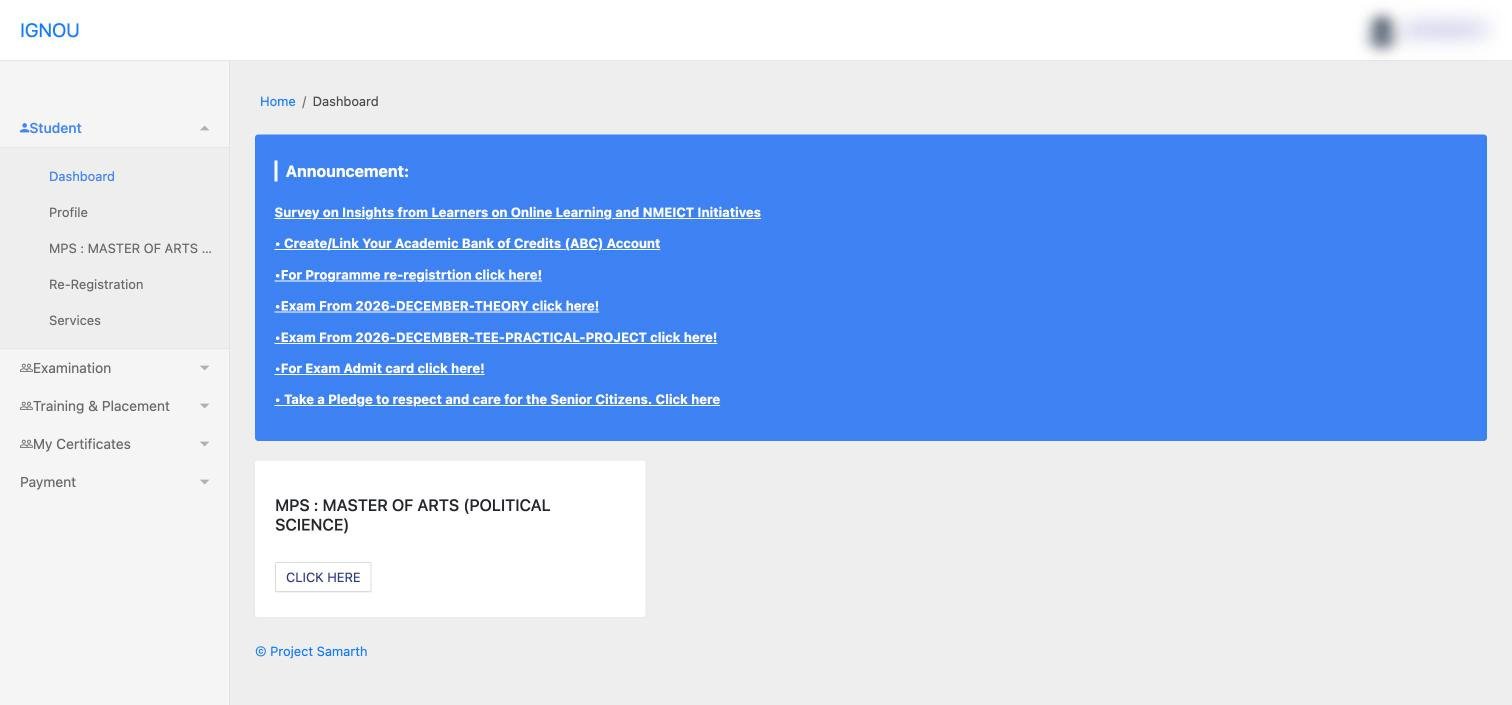
Students admitted in recent sessions see their programme in IGNOU’s Samarth portal. Make sure the programme name and code match what you applied for. An institute that claims to award IGNOU degrees outside IGNOU’s own admission system is not IGNOU.
Keep your official documents
IGNOU’s online grade card status page itself states that it is “indicative only” and “cannot be used as a substitute for the final grade card”. Employers and universities will want the grade card and degree certificate IGNOU issues. Our convocation guide explains how the degree reaches you.
What recognition doesn’t settle
Equivalence means your IGNOU degree is treated like a regular degree of the same kind. It doesn’t override the specific conditions of a vacancy or an admission. A notice may ask for a particular subject combination, minimum marks, a professional licence, a qualifying test, or occasionally a degree “in regular mode”. Read those conditions and ask the recruiter or institution if you’re unsure, before you apply.
Before you apply for any post
Read the eligibility section of that specific notice. Recognition establishes that your degree counts; the notice decides whether it fits.
Jobs and higher study
Government jobs: where a notice asks for a degree from a recognised university, an IGNOU degree meets that description. Students our team has worked with have gone on to jobs in banking, administration and the police. Many UPSC and state-exam aspirants choose IGNOU for the flexibility; our guide on choosing an IGNOU MA for UPSC goes into that.
Private jobs: skills and experience usually matter more than the mode of study. Some IGNOU BCA and MCA graduates known to our team work at software companies in Noida and Bengaluru, and some MBA students used the degree towards promotions with their existing employers. These are examples from students we know, not survey results.
Higher study: an IGNOU master’s can be used to meet UGC NET and PhD eligibility like any recognised master’s, subject to the minimum marks and the admitting institution’s own process. Some of our MA students have qualified NET and JRF.
Abroad: foreign universities and professional bodies run their own assessments, and the outcome depends on the country, the body and the degree. ACCA, for example, lists IGNOU in its calculator but assesses graduates individually, as our ACCA guide shows.
The “why distance?” question
You may be asked this in an interview. In our experience it’s usually curiosity. A straightforward reason works well: you were working, preparing for competitive exams, or had family responsibilities. Then talk about what you learned and what you’ve done. Among the students we support, the BCA, BBA, MCA and MBA are the programmes most often chosen to support a promotion at an existing job. If that’s your aim, check your employer’s HR policy on qualifications before enrolling.
Guides by programme
Which IGNOU MA helps with UPSC?Matching an MA to your optionalIs the IGNOU B.Ed valid?Apply, admission and jobsIGNOU courses for BAMS graduatesMBA vs PG diplomaMA History books for UGC NETUnit-by-unit mappingIs a BCA from IGNOU worth it?Three years, year by yearHow tough is an MA Economics?MEC-203 and MEC-103Careers after MA Environmental StudiesRoles and what they needACCA exemptions for IGNOU B.ComOne dated calculator checkCompleting the MAJMC practicalsWhat each manual asks for
Questions students ask us
Is an IGNOU degree equal to a regular degree?
IGNOU’s prospectus states its degrees are at par with corresponding degrees of Indian universities, and UGC regulations treat ODL degrees as equivalent to conventional ones. Specific vacancies can still add their own conditions.
Why can’t I find IGNOU on the UGC-DEB list?
IGNOU’s prospectus cites a UGC letter exempting it from the ODL regulations that govern that list, and states that its programmes are at par with DEB-approved ones.
Can I do a PhD after an IGNOU master’s?
An IGNOU master’s can count towards PhD eligibility like any recognised master’s, subject to minimum marks and the university’s own admission process.
Can I study at IGNOU while working full time?
Most IGNOU programmes are designed for that. It’s how many of our students, and I, completed our degrees.
Sources checked 11 November 2026
- IGNOU Common Prospectus, July 2026 (Act, AIU recognition, UGC exemption letter)
- UGC regulations compendium (equivalence of ODL degrees)
- ignou.ac.in (NAAC and NIRF badges)